

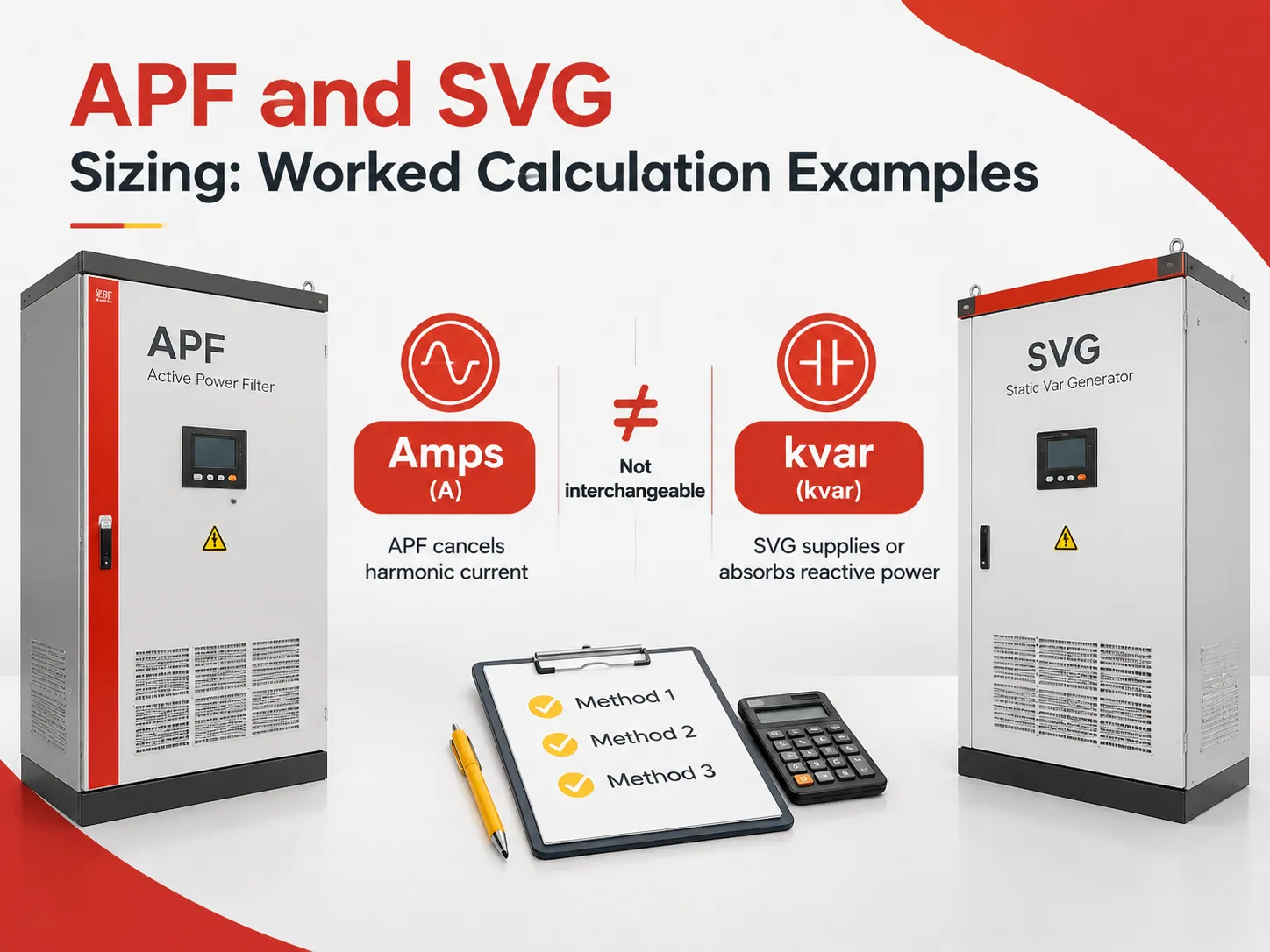
Two devices, two units, one recurring mistake. People size an APF in kvar and an SVG in amps, then wonder why the quotation does not match the site. The units are not interchangeable, because the two devices are not doing the same work.
An APF (active power filter, also called an active harmonic filter or AHF) is rated in amperes, and that figure is the harmonic current it can cancel. An SVG (static var generator) is rated in kvar, and that figure is the reactive power it can supply or absorb. Get the unit right and the calculation becomes straightforward. Three methods cover most projects, and each one is worked through with real numbers.
How to Size an APF in Amps
Method 1: Measure the harmonic current (most accurate)
Put a power quality analyser on the main incoming panel and log for 24 hours, long enough to cover a full production cycle. You want two numbers from the peak period: the fundamental current (I1) and the total harmonic current distortion (THDi).
Required APF capacity (A) ≥ I1 × THDi × 1.2
Say the analyser records a fundamental current of 200 A with THDi at 25%. That gives 200 × 0.25 = 50 A of harmonic current, and with the 1.2 factor you specify a 60 A unit.
If your analyser breaks out individual orders, be more precise: total harmonic current is the square root of the sum of squares of the 3rd, 5th, 7th and higher order currents. Then apply the same 1.2 factor.
On margin: 20% is enough for a normal load profile. Where motors start and stop often, take 30%, because the harmonic surge at start-up is sharper than the steady-state figure suggests.
Method 2: Estimate from transformer capacity (rough reference only)
No analyser, no shutdown window, no historical data? Estimate from the transformer rating. For most light industrial sites the harmonic current lands between 10% and 15% of transformer capacity; heavy converter populations push it much higher.
| Site type | Suggested APF capacity (% of transformer capacity) |
|---|---|
| Light industry, few VFDs | 10%–15% |
| Machining, mostly VFD-driven | 20%–30% |
| Injection moulding | 25%–35% |
| EV charging station | 30%–50% |
For a 1000 kVA transformer feeding a plant full of VFDs, that puts you at roughly 200–300 A. Treat this as a placeholder for budgeting, not as a specification. Measurement is always better, and the difference between an estimate and a measurement is often a whole size step.
Method 3: Calculate from transformer capacity and an assumed THDi
The middle path uses transformer data plus an industry-typical distortion figure. Take a chemical plant: 2000 kVA transformer, 10/0.4 kV, load factor 0.7, THDi assumed at 35%.
The calculation lands at about 667 A of harmonic current. Multiply by 1.3 and you get 867 A, so a 900 A configuration is selected. That 1.3 factor covers the gap between an assumed THDi and whatever the plant actually produces; if you can measure even one week of data, use it instead.
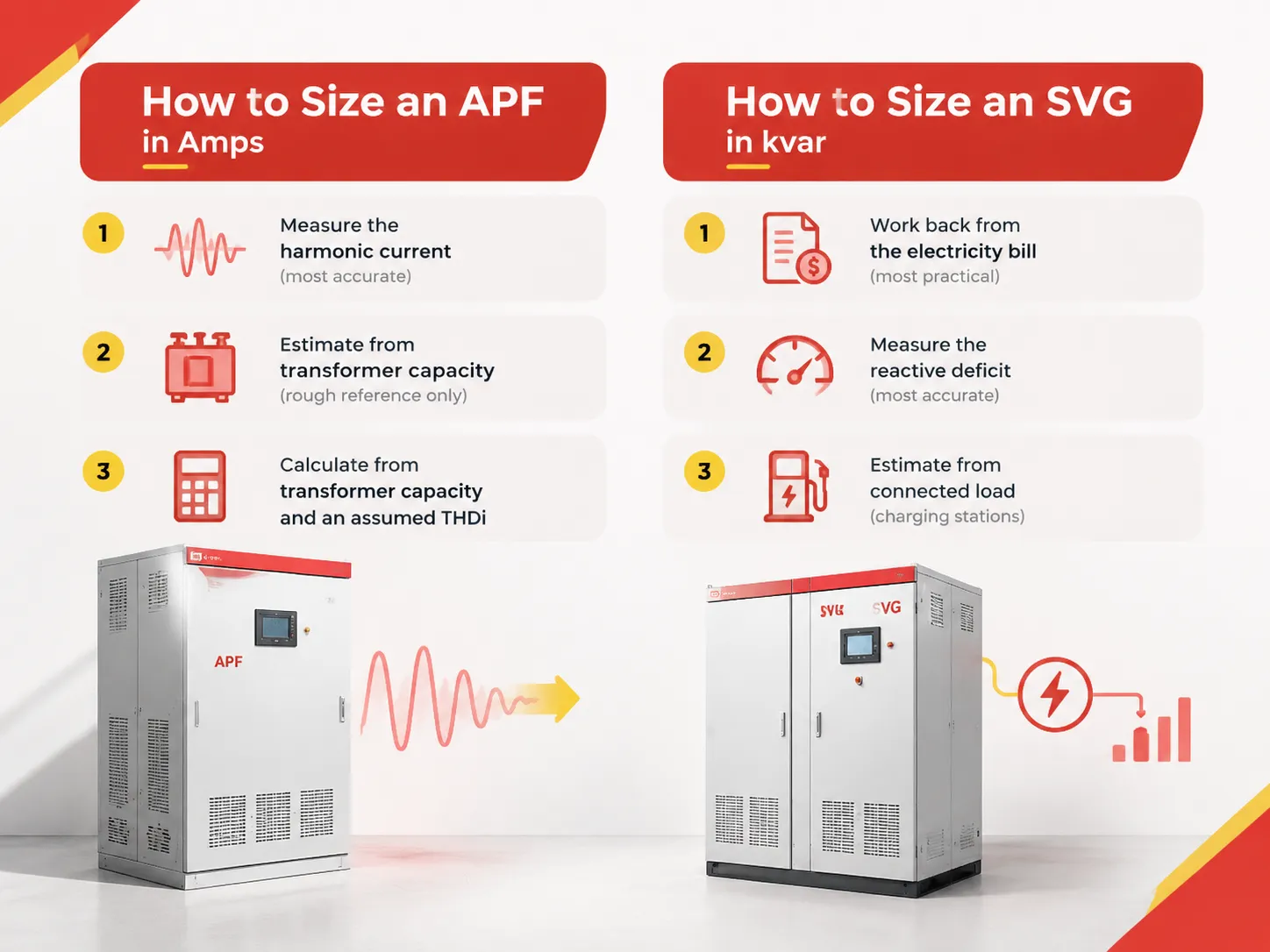
How to Size an SVG in kvar
Method 1: Work back from the electricity bill (most practical)
The bill already tells you what you need. Take active energy and reactive energy for the same period.
Step 1 — current power factor: cosφ = active energy ÷ √(active energy² + reactive energy²)
Step 2 — target power factor. 0.95 is where most utilities stop penalising, and pushing past 0.98 usually costs more than it saves.
Step 3 — compensation required: Qc = P × (tanφ1 − tanφ2)
Worked example: one month with 100,000 kWh active, 80,000 kvarh reactive, 720 operating hours. The power factor works out at about 0.78, and average active power at about 139 kW. Lifting 0.78 to 0.95 needs roughly 0.5 kvar per kW, so about 70 kvar in total.
Method 2: Measure the reactive deficit (most accurate)
Use a power analyser to capture the largest reactive power deficit across the load cycle, then specify 1.2 times that value. This is the only method that accounts for the worst fifteen minutes of the month rather than the monthly average, and the peak is what the utility charges on.
Method 3: Estimate from connected load (charging stations)
For a new installation with no operating history, work from the load itself. Ten 120 kW DC fast chargers give 1200 kW connected. Chargers typically run at a power factor around 0.85, and the target is 0.95.
Q = 1200 × (0.6197 − 0.3287) = 349.2 kvar. Apply a simultaneity factor of 0.8, since not every charger runs flat out at once, which gives 279 kvar. Add a 15% margin and the selection is 350 kvar.
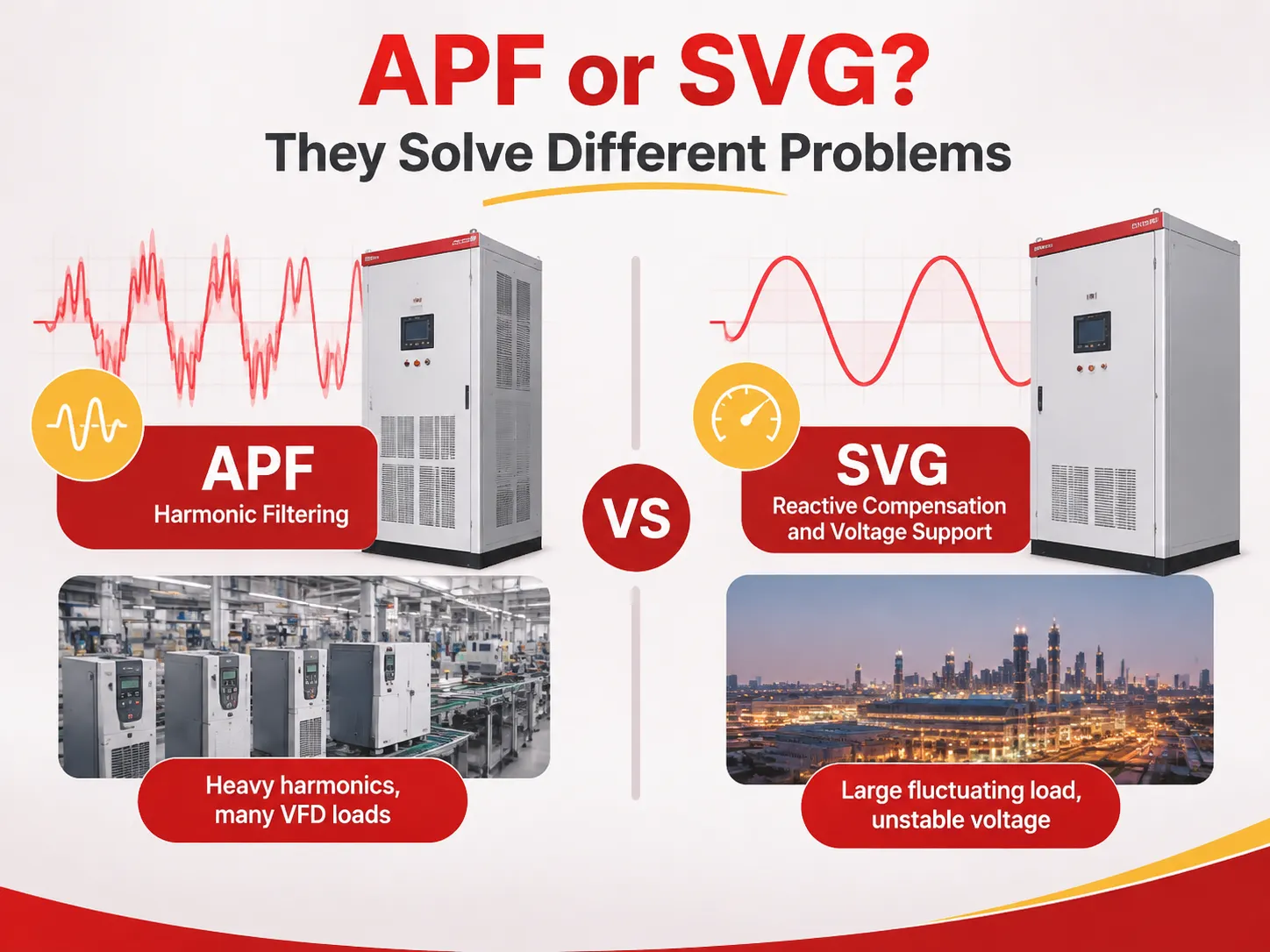
APF or SVG? They Solve Different Problems
The choice is not a matter of capacity. It follows from what is actually wrong on site. If the waveform is distorted, you need an APF. If the power factor is low and the voltage wanders, you need an SVG.
| Item | APF | SVG |
|---|---|---|
| Unit | A | kvar |
| Core function | Harmonic filtering | Reactive compensation and voltage support |
| Response | 5–20 ms | Under 5 ms |
| Typical site | Heavy harmonics, many VFD loads | Large fluctuating load, unstable voltage |
| Can it do the other job? | Some reactive capacity, but not cost-effective | Some harmonic filtering, but limited |
| Cost | Medium to high | High |
Two Cases From Real Projects
Harmonic mitigation at an electronics manufacturer. The team started with an on-site survey rather than a quotation: harmonic measurement at the main panel, order-by-order analysis, then cross-checking against the applicable standard. Only then did they fix the APF rating and, just as importantly, the installation point. The result was good enough to be reused as a template for the company’s other plants. The lesson is that the installation point matters as much as the capacity; an APF connected upstream of the offending load is compensating for everyone else’s harmonics too.
SVG at a 1200 kW charging hub. Ten 120 kW chargers, power factor sitting at 0.85 during operation, load swinging hard as vehicles arrive and leave. Applying the calculation above gives 349.2 kvar, de-rated by the 0.8 simultaneity factor and lifted by a 15% margin to a 350 kvar unit. Power factor now holds above 0.95 through the day and the reactive adjustment charge has disappeared from the bill.
Three Sizing Details That Change the Answer
Three-wire or four-wire? Ordinary industrial loads run three-phase three-wire and a three-wire APF is the right choice. Sites with large numbers of LED drivers, computers and single-phase rectifiers need a four-wire unit with neutral compensation, because the third harmonic adds in the neutral instead of cancelling.
Bigger is not better for SVG. An SVG is the fine-adjustment device in a mixed scheme; capacitors carry the base load because they are far cheaper per kvar. On a 2500 kVA transformer, 800 kvar of capacitors plus a 200 kvar SVG gives 1000 kvar of compensation and handles both the steady demand and the swings. Sizing the whole 1000 kvar as SVG is technically defensible and commercially hard to justify.
Let each device do its own job. APF selection comes down to three things: measure the harmonics, leave margin, confirm the topology. SVG selection comes down to three more: calculate the reactive requirement, watch the load fluctuation, and let capacitors carry the base while the SVG finishes the job.
FAQ
Why is the APF rated in amps instead of kvar?
Because its job is to inject a current, not to supply reactive power. The harmonic current it has to cancel depends on the load current and the distortion level, not on the transformer size, so the rating follows amperes.
Can one device handle both harmonics and reactive power?
Partly. An APF can supply some reactive current and an SVG can suppress some low-order harmonics, but both are doing a second job with limited headroom. Where both problems are significant, a combined APF plus SVG scheme works out cheaper than one oversized hybrid device.
What margin should I leave?
20% for a normal load profile, 30% where motors start and stop frequently. For SVG sizing on a new site, a 15% margin on top of a simultaneity factor is a reasonable starting point.
Do I need a measurement campaign before ordering?
For anything above a few hundred amps of harmonic current, yes. A week of logging costs far less than exchanging a 400 A unit for a 600 A one after commissioning.