

Walk into almost any industrial site built or upgraded in the last fifteen years and you will find VFDs. Walk into the workshop and you will find LED drivers on every fitting. Both are non-linear loads, and both inject harmonic current into the supply while they run.
For a capacitor in a compensation cabinet, that harmonic current is not background noise. It is being delivered straight to the terminals.
Why a Capacitor Is a Harmonic Magnet
A capacitor’s reactance is inversely proportional to frequency: Xc = 1/(2πfC). Double the frequency and the impedance halves. Go from 50 Hz to 250 Hz, the 5th harmonic, and the capacitor presents one fifth of the impedance it presents to the fundamental.
So the higher the harmonic order, the lower the impedance path through the capacitor. Harmonic current takes it. The result shows up as heat in the dielectric, bulging cases, and fuses that blow, get replaced, and blow again.
There is a second mechanism that makes it worse. The capacitor and the supply inductance form a parallel resonant circuit. If the resonant frequency lands near a harmonic that the site generates in quantity, the harmonic is amplified rather than absorbed, and the voltage distortion at the busbar can rise well above what the loads alone would produce.
The Most Common Thing You Will See: a Naked Bank
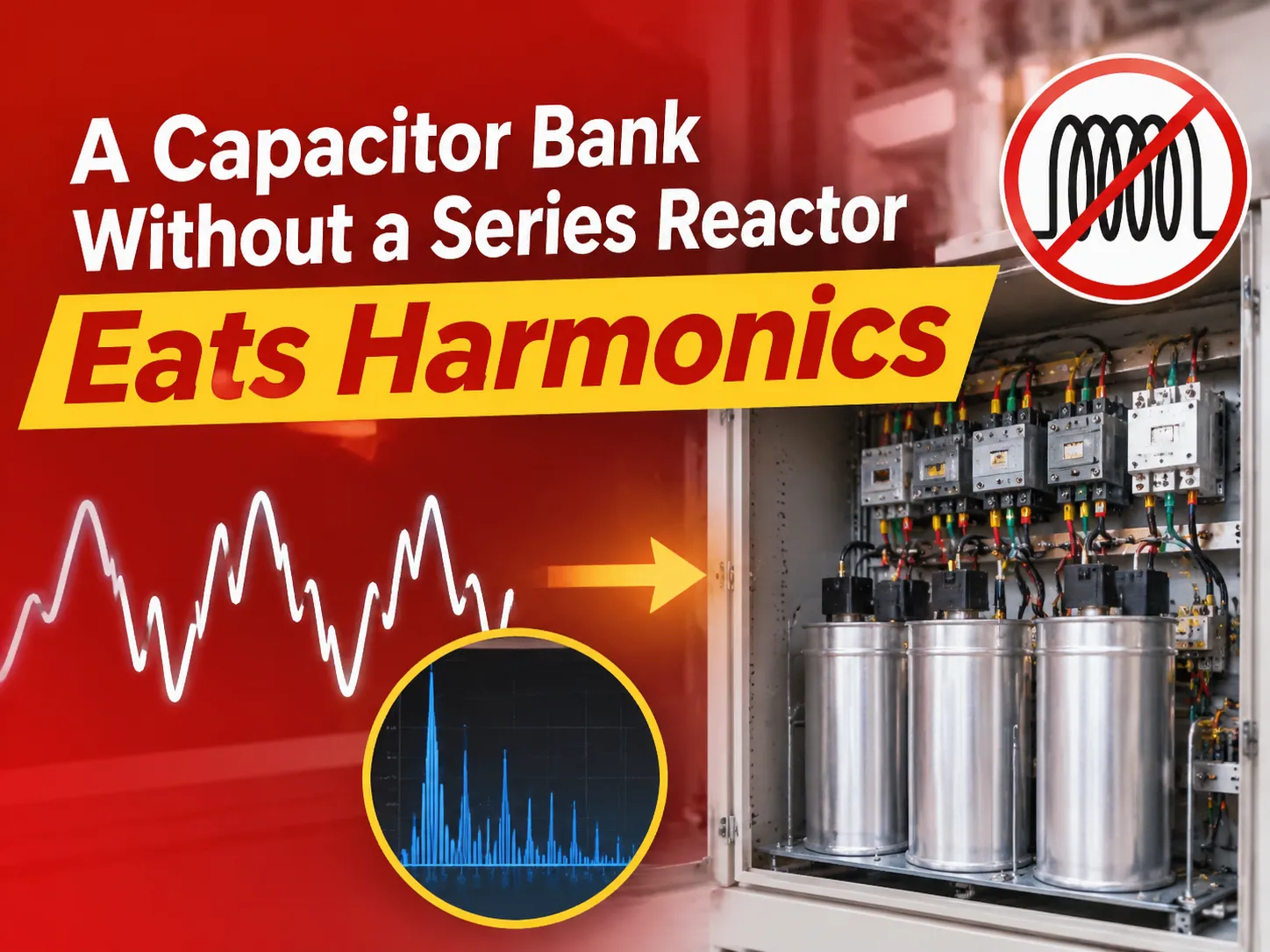
Capacitors bolted directly to the busbar, contactors and fuses, no reactor anywhere in the circuit. Ask why and the answer is usually that the supplier said it wasn’t necessary.
Whether that advice was commercial or technical is answered by measurement. In an environment where THDi runs above 40%, an un-detuned capacitor bank is a consumable item. It will do its job for a while and then it will fail, and it will fail repeatedly.
Two Signals That Confirm the Diagnosis
The capacitors bulge, get replaced, and bulge again. A single swollen capacitor is a component failure. A pattern of repeated swelling on the same bank is a system problem, and harmonics are the first thing to check.
Look at the load mix. VFDs, soft starters, UPS systems, induction furnaces, large LED installations, rectifier-based processes. If the plant has them, harmonics are being generated, and the question is only how much.
Neither signal replaces a measurement, but between them they tell you whether a survey is worth commissioning.
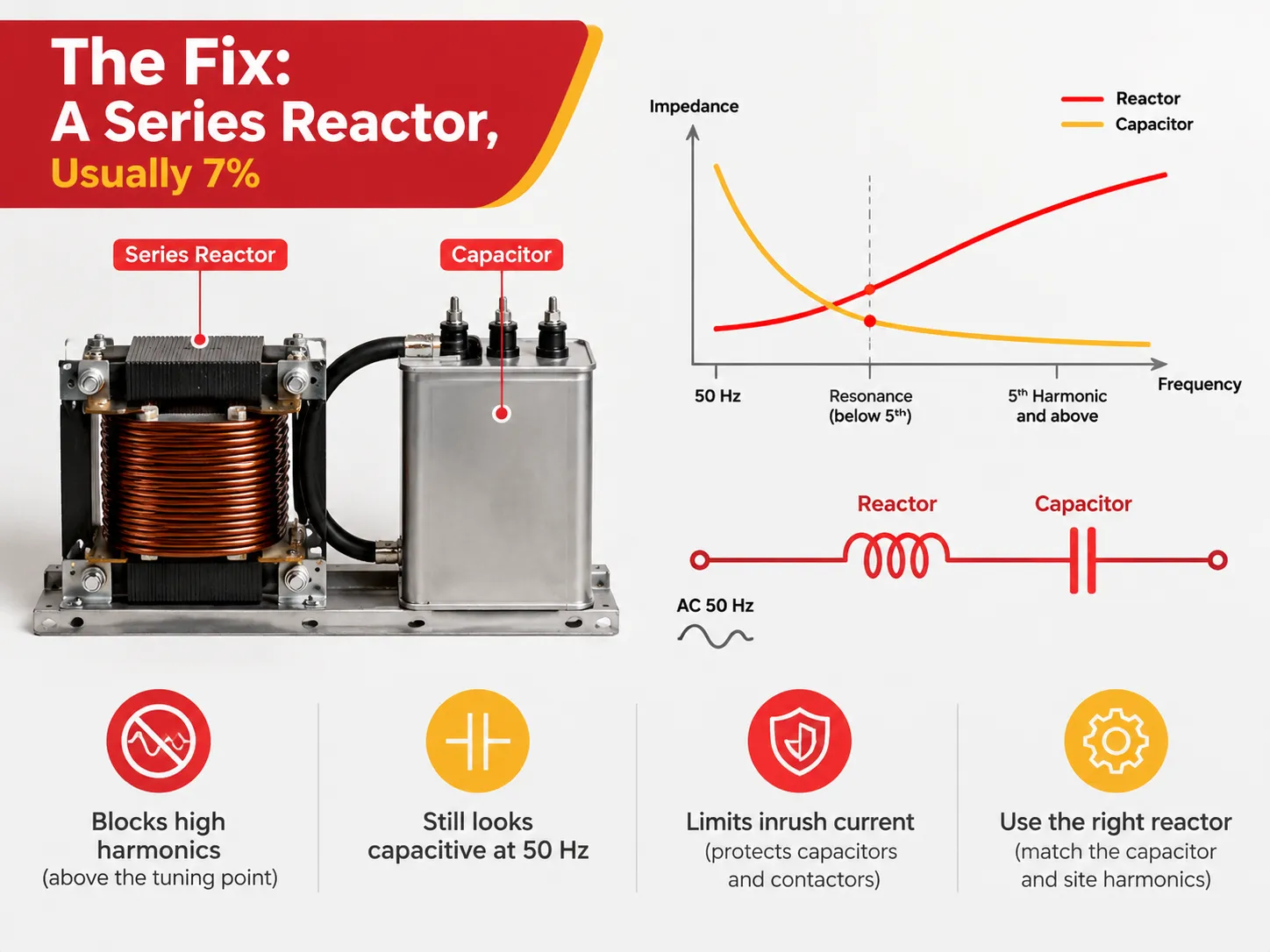
The Fix: a Series Reactor, Usually 7%
Put a reactor in series with the capacitor. The reactor’s impedance rises with frequency, the capacitor’s falls, and the series combination presents a high impedance to harmonics above the tuning point while still looking capacitive at 50 Hz.
7% is the standard reactance rate for a few reasons. It moves the series resonance below the 5th harmonic, so the 5th and everything above it is blocked from the capacitor rather than drawn into it. It also limits the inrush current when the contactor closes, which is the other thing that kills capacitors and contactors on a busy bank.
Ordering a cabinet with reactors specified is not a detail to leave to the supplier. The reactance rate has to match the capacitor it is paired with, and the pair has to be selected against the site’s actual harmonic spectrum. A reactor chosen for a different capacitor rating will detune the branch and can make the resonance problem worse rather than better.
The other thing to communicate at order stage is the load composition. A supplier who knows the site runs six-pulse drives and an induction furnace will select differently from one who assumes a generic mix.
Where 7% Is Not Enough
Third harmonic. It is a zero-sequence component, so it behaves differently from the 5th and 7th, and a 7% reactor does very little against it. Sites dominated by single-phase electronic loads, office-heavy buildings, LED-dominated lighting circuits, need a different approach: 14% reactance moves the tuning point below the 3rd harmonic, and in some cases the answer is filtration rather than detuning.
This is why the harmonic spectrum matters more than the total distortion figure. Two sites with identical THDi can need completely different reactors if one is dominated by the 5th and the other by the 3rd.
Practical selection guidance, in short: 5th and above dominant, choose 7%; significant 3rd harmonic, choose 14%; heavy distortion with a clear dominant order, consider a tuned filter branch instead.
Pitfalls Worth Knowing
Reactors get hot. They carry the capacitor current plus the harmonic current, and they dissipate real losses. Cabinet ventilation and over-temperature protection are part of the design, not optional extras. A reactor cooked by a poorly ventilated cabinet is a fire risk, not just a failure.
Inter-turn shorts happen. A reactor with a shorted turn loses inductance, detunes the branch, and can overheat without any obvious external sign. Periodic thermographic inspection catches most of them before they become incidents.
Cost arithmetic is one-sided. The price difference between a bank with reactors and one without is a small percentage of the cabinet. The difference between replacing capacitors annually and not replacing them at all is not.
If you are specifying replacement hardware, the low-voltage filter reactors are matched to the capacitor range so that the reactance rate and the capacitor rating are selected as a pair rather than assembled from whatever is on the shelf.
FAQ
Can I add reactors to an existing bank?
Sometimes. The capacitors must be rated for the higher voltage that appears across them with a reactor in series, and the physical space inside the cabinet usually decides whether it is practical. In most cases a new detuned bank is cheaper than a retrofit.
Does a reactor reduce the compensation capacity?
It slightly reduces the effective kvar at the busbar, because part of the voltage appears across the reactor. Detuned banks are usually specified at a marginally higher capacitor rating to compensate.
How do I know which reactance rate I need?
From a harmonic measurement at the busbar where the bank is installed. 7% is a default for 5th-dominant sites, 14% where the 3rd is significant. Guessing produces either an over-designed bank or a detuned one that does not detune.
Is a detuned bank the same as a filter?
No. A detuned bank avoids drawing harmonics into the capacitor. A tuned filter branch is designed to absorb a specific harmonic. The first protects the equipment; the second treats the network.