

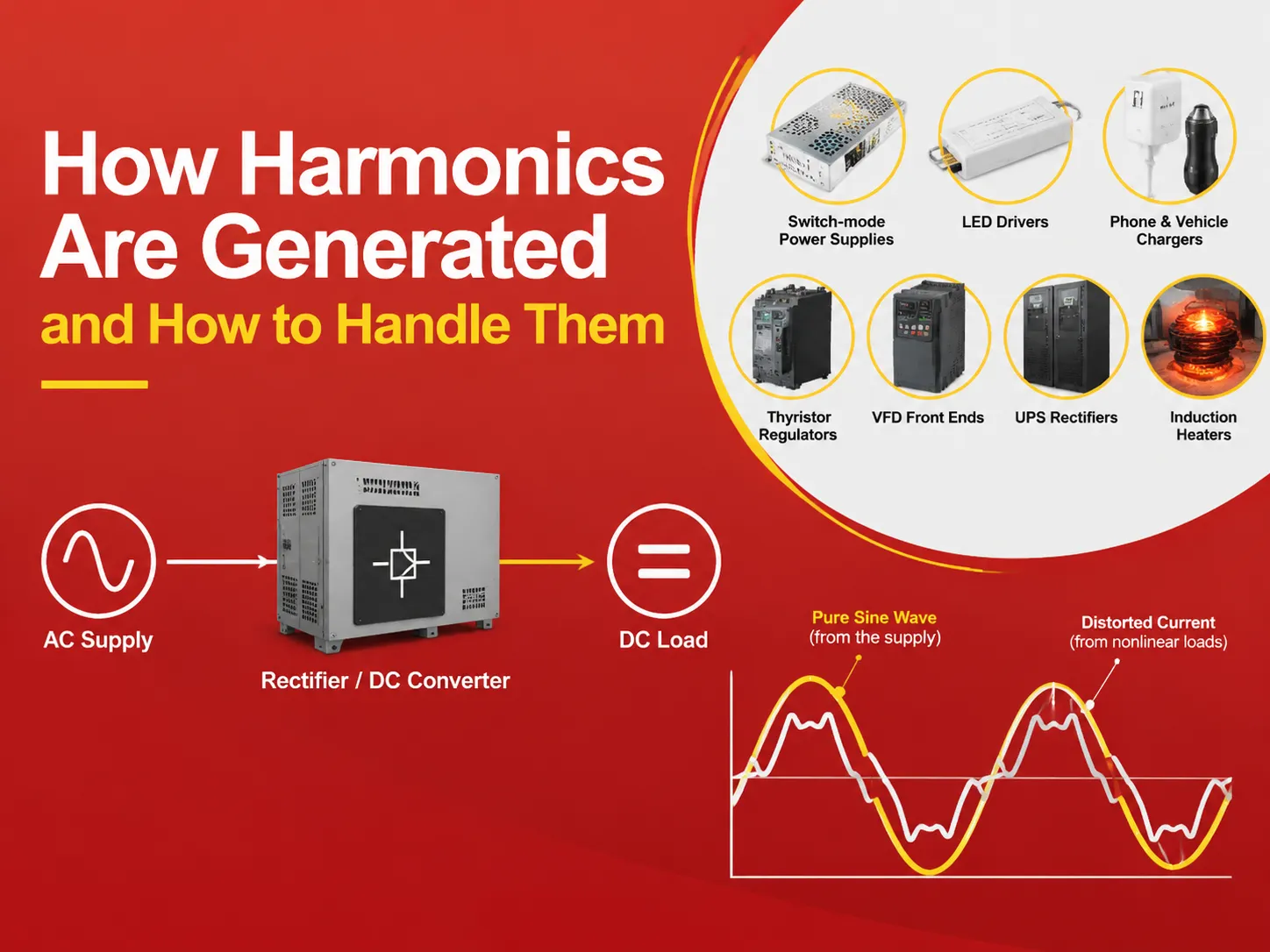
Harmonics do not come from the supply. They come from the loads, and specifically from loads that convert alternating current into direct current.
That covers more equipment than most people expect: switch-mode power supplies, LED drivers, phone and vehicle chargers, thyristor regulators, VFD front ends, UPS rectifiers, induction heaters. Nearly every efficiency improvement of the past two decades has been delivered by a rectifier, and every rectifier distorts the current it draws.
Where Harmonics Come From
A rectifier conducts in short pulses around the peak of the voltage waveform, not smoothly across the whole cycle. That pulsed current is what the supply sees, and a pulsed waveform is mathematically a fundamental plus a series of higher-order components. The 3rd, 5th, 7th and so on are the harmonics.
On a three-phase six-pulse drive, the characteristic orders are 5th, 7th, 11th and 13th, and they largely cancel between phases. Single-phase electronic loads behave differently, and that difference is what makes them so destructive on a neutral conductor.
Why the 3rd Harmonic Is the Dangerous One
The 3rd harmonic, along with the 9th and 15th, is a zero-sequence component. In all three phases it has the same magnitude, the same direction and the same phase angle.
Balanced fundamental currents cancel in the neutral. Balanced 3rd harmonic currents do not cancel. They add.
So on a distribution board feeding offices, LED lighting or a bank of chargers, the neutral current does not tend toward zero as the phases balance. It trends toward three times the 3rd harmonic current in a single phase, and can end up higher than the phase current itself.
What That Does to the Neutral
Neutral conductors were historically sized at half the phase conductor, on the assumption that they only carried unbalance. That assumption is wrong for an electronic load mix.
A neutral carrying more current than its phase conductor heats up. Terminations discolour, insulation hardens, and eventually the conductor opens. When it does, the single-phase loads downstream are suddenly connected line-to-line through each other, and the phase with the lightest load sees a voltage rise it was never designed for. The resulting damage is usually attributed to “a power surge” because that is what it looks like.
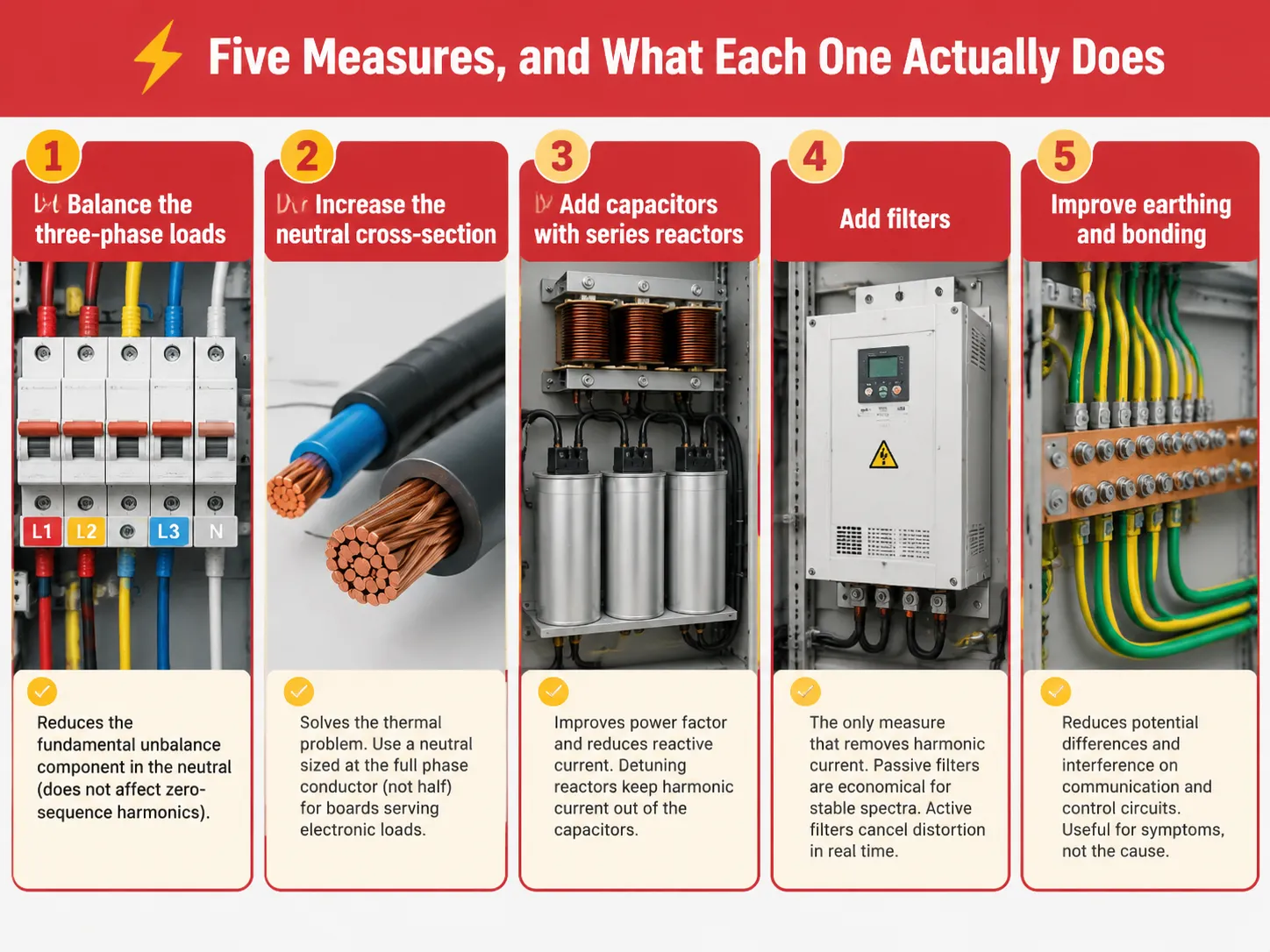
Five Measures, and What Each One Actually Does
1. Balance the three-phase loads. The cheapest measure and the one most often skipped. It reduces the fundamental unbalance component in the neutral, though it does nothing for the zero-sequence harmonics, which add regardless of balance.
2. Increase the neutral cross-section. Straightforward and effective for the thermal problem. On new installations, sizing the neutral at the full phase conductor rather than half is the right default for any board serving electronic loads. It does not remove the harmonic, it just stops the conductor failing because of it.
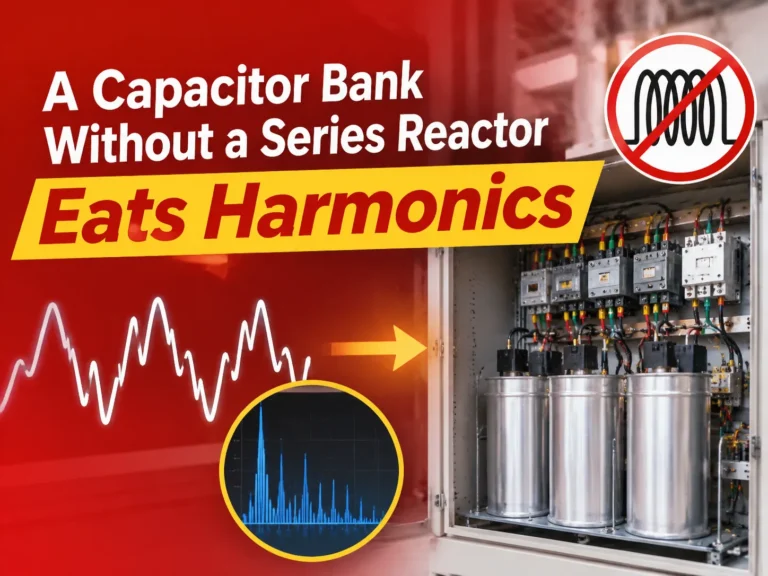
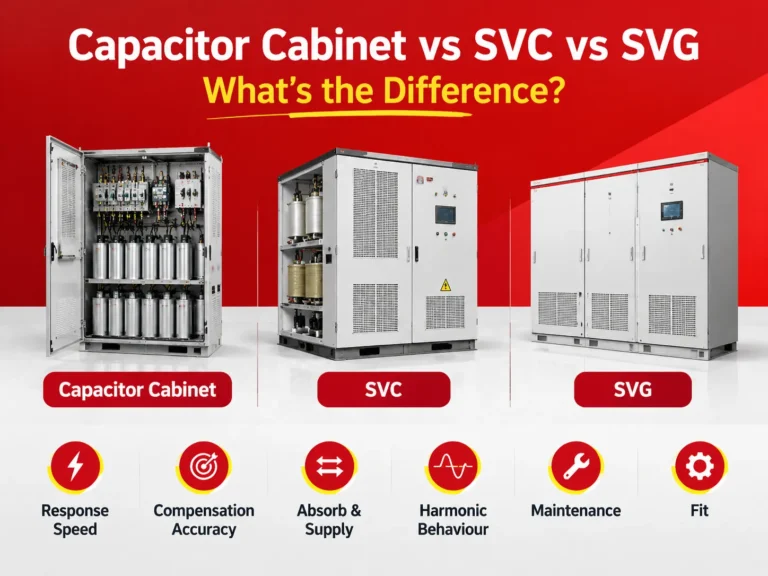
3. Add capacitors with series reactors. Compensation reduces the reactive component and improves power factor, and detuning reactors keep harmonic current out of the capacitors. Note what this does not do: it does not reduce the harmonic current in the neutral, so it is not a fix for the problem described above.
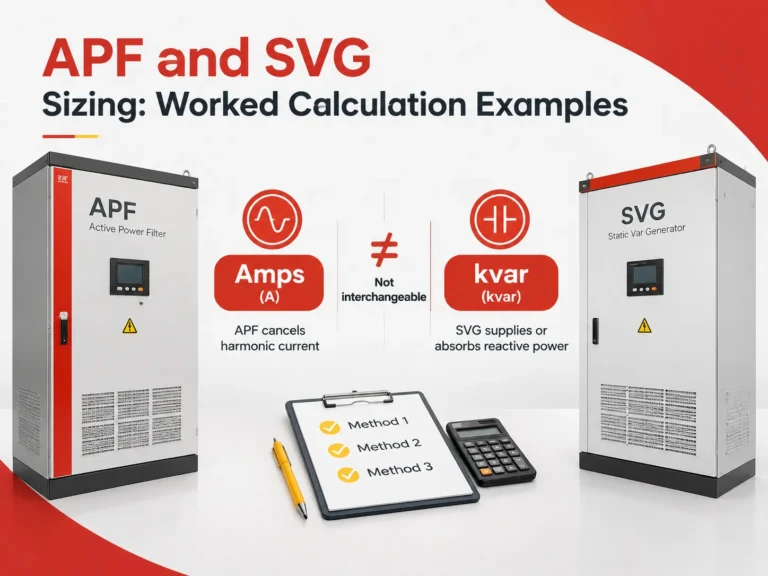
4. Add filters. The only measure that removes harmonic current rather than tolerating it. Passive filters are tuned to a specific order and are economical where the spectrum is stable. Active filters measure the distortion and cancel it in real time, which is what a site with a changing load mix needs.
5. Improve earthing and bonding. Repeat earthing and solid bonding reduce potential differences and interference on communication and control circuits. Useful for the symptoms, not the cause.
When Filtration Becomes Necessary
The trigger is usually one of these four observations:
- Voltage distortion at the busbar above the 5% limit, with equipment failing or refusing to run.
- Transformers, cables or switchgear running hot at a load that should not produce that much heat.
- Capacitor banks that trip, refuse to switch in, or bulge repeatedly even with reactors fitted.
- Neutral currents above the phase currents on a board serving electronic loads.
An active filter handles all four at once because it works on the current rather than on a single frequency. For sites where the neutral is the main problem, a four-wire unit with neutral compensation is required; a three-wire device has no path for zero-sequence current and cannot help. The active filter range covers both topologies, and the distinction is worth confirming in writing before ordering.
For sites where the distortion is modest and the budget is not, a harmonic protector installed at the incoming point can reduce the stress on the installation without the cost of full active filtration. It is a mitigation measure rather than a cure, and it should be specified as such.
FAQ
Does a VFD always create harmonics?
Its front-end rectifier does. How much reaches the supply depends on whether it is a six-pulse bridge, a twelve-pulse arrangement, or a drive with an active front end and built-in filtering.
Can I just oversize the neutral and forget about it?
On a single board with moderate distortion, often yes. On a plant where the load is growing, no: the harmonic current grows with the load, and you will be oversizing again in three years.
Do harmonics really cost money?
They do, through losses in transformers and cables, reduced equipment life, nuisance tripping, and in some tariffs through distortion-based charges. The costs are distributed across maintenance and downtime budgets rather than appearing on one line of the bill, which is why they get ignored.
What is the difference between THDu and THDi?
THDu is voltage distortion at the busbar and is what the 5% limit applies to. THDi is current distortion drawn by a load. High THDi from a small load may be harmless; high THDu affects everything connected to that busbar.