


The current generation of electrical systems seems to be more complicated than at any time before. All forms of industry including manufacturing and distribution of renewable energy products rely heavily upon various types of power electronics equipment that includes such devices as variable frequency drives (VFDs), UPS systems, solar inverters, and EV chargers. It should be noted that all these technologies possess both value in increasing efficiencies as well as the problems of harmonic distortion and degrading power quality.
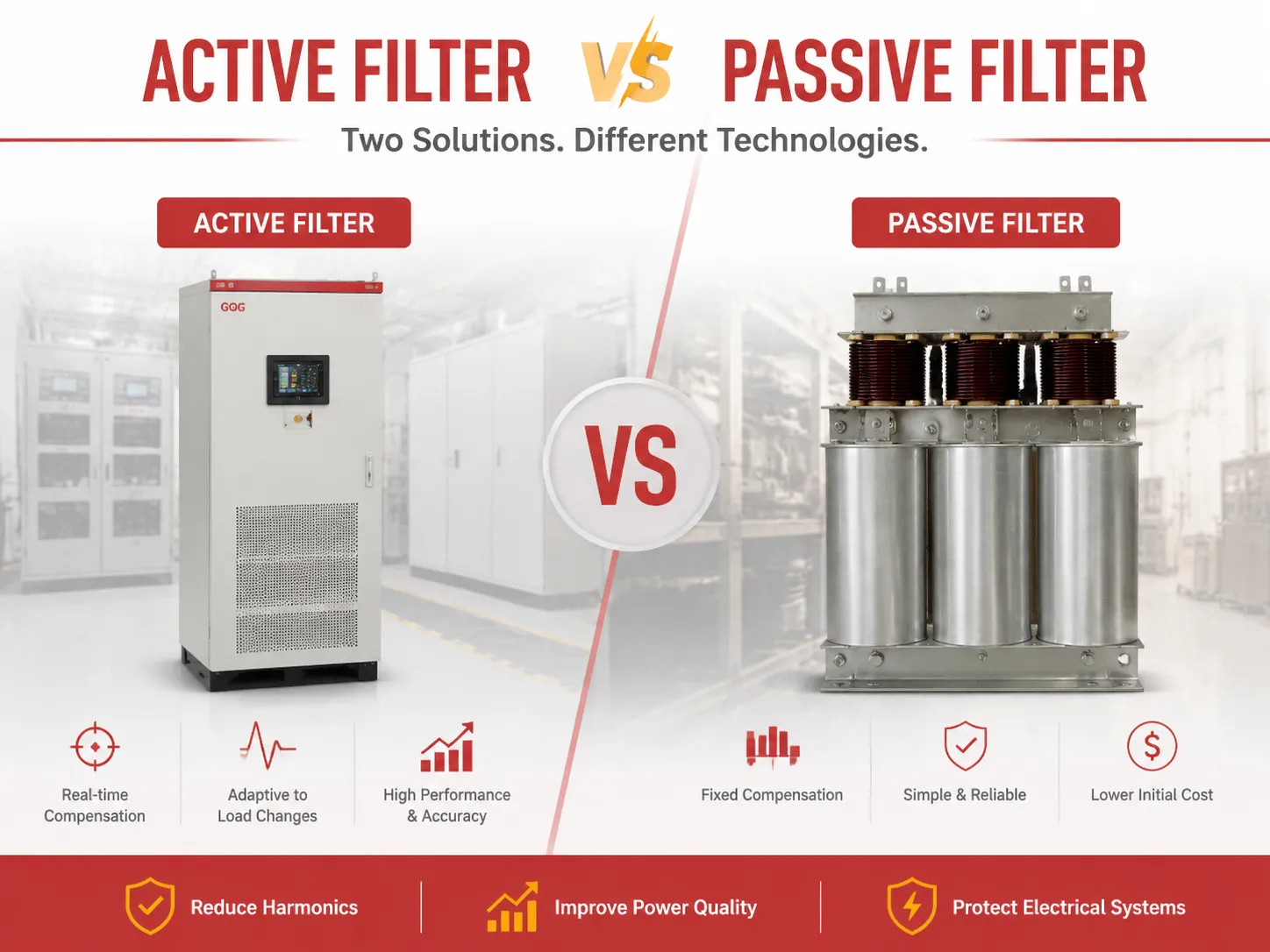
In situations when engineers wish to eliminate harmonics and increase performance of electric power, they can explore two popular alternatives: active filters and passive filters. Although both approaches target harmonic issues, they take a different approach to accomplishing this goal.
What distinguishes an active filter from a passive filter? Which is better suited for your needs? The answer depends on various factors including the harmonic properties of the filtering system, load variations, installation environment, and long-term operational requirements.
This guide provides an overview of active filters and passive filters, the manner in which they operate, as well as their pros and cons, their usual uses, the cost differences between them, and the way to select the right harmonic filtering solution for your electrical installation.
What Is an Active Filter?
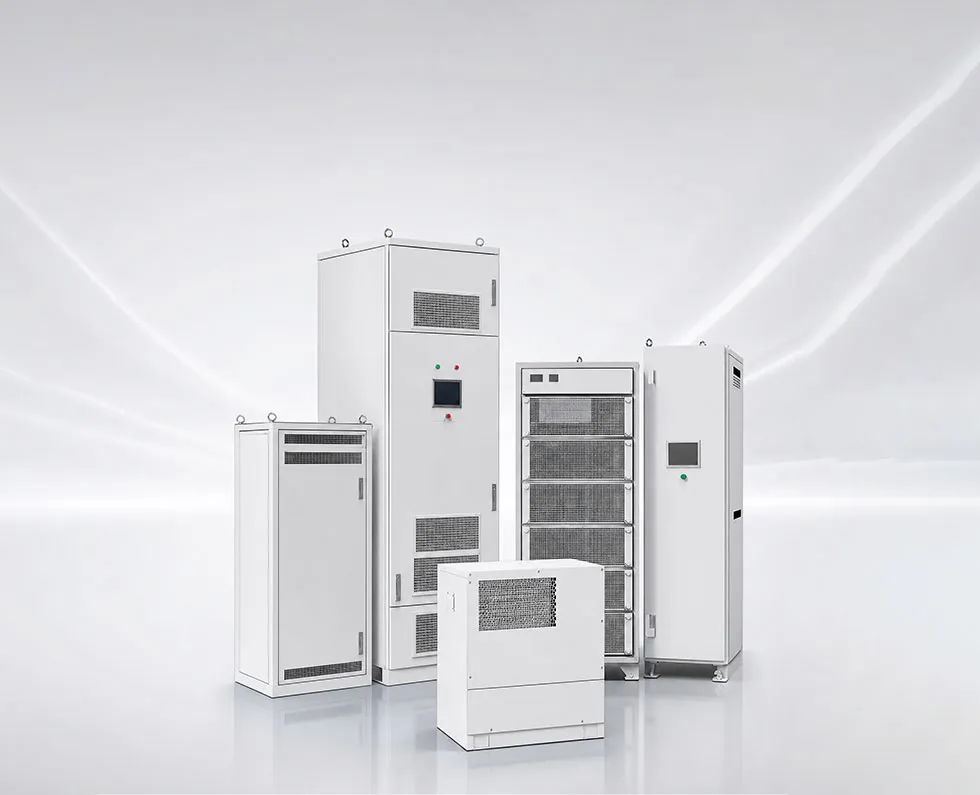
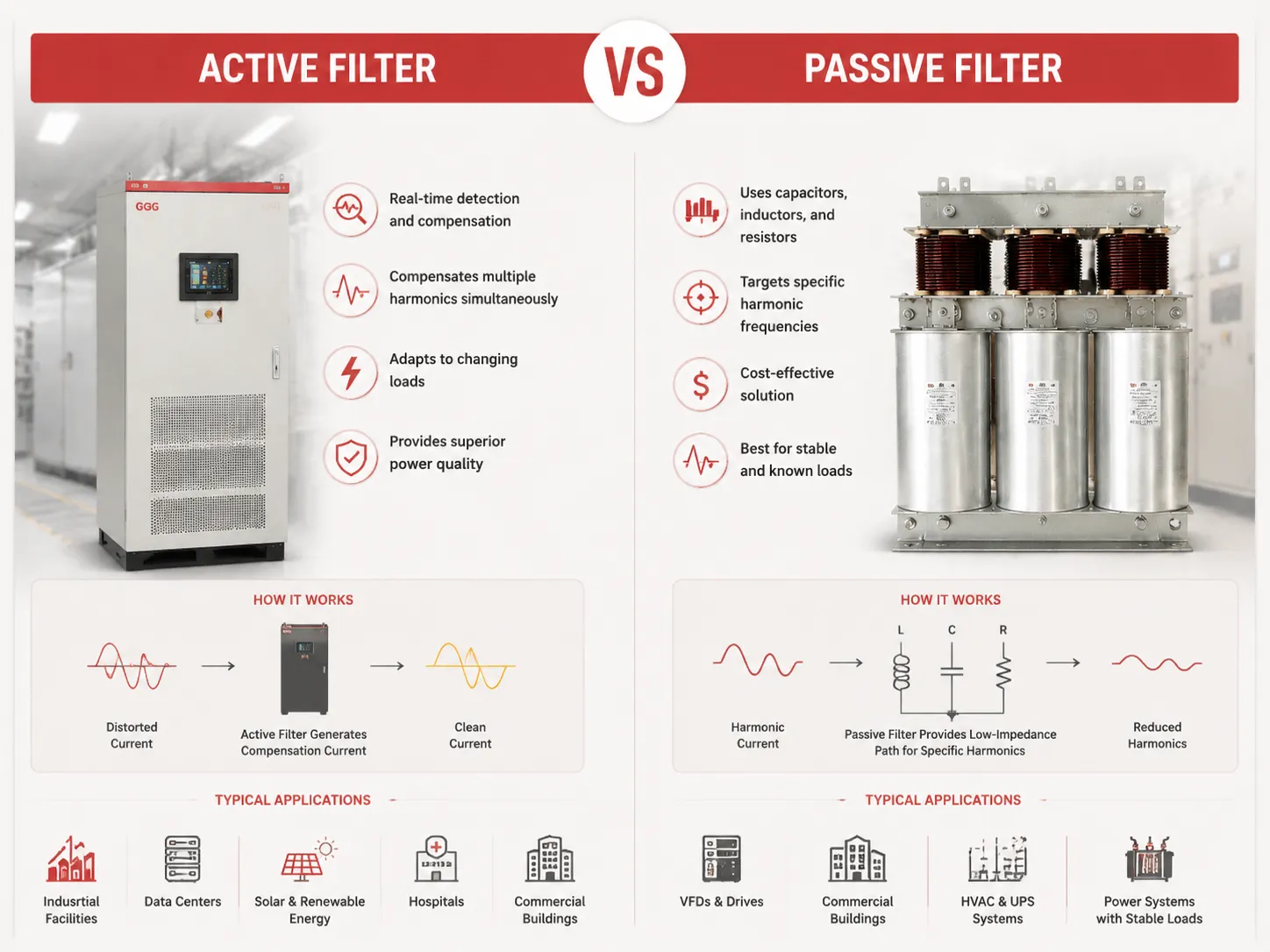
An active filter, which is also known as an active harmonic filter (AHF) or an active power filter (APF), is an advanced device that is used for power quality. This device utilizes the principles of power electronics for monitoring and compensation of distortion of signals. The active filter is able to do this in a real time.
Compared to the standard filtering systems that operate at fixed frequencies, an active filtering system continuously observes the electrical wave shape and generates a compensation current, tracing the unwanted harmonic currents caused by non-linear loads.
An active filter, in other words, examines an electrical issue and creates an inverted signal to fix it.
Active filters find applications in situations where the electrical load frequently changes or where strict levels of power quality are required following usages of active filters:
- Industrial manufacturing facilities
- Data centers and communication facilities
- Solar and renewable energy systems
- Hospitals and critical infrastructure
- Commercial buildings with sensitive equipment
What Is a Passive Filter?
A passive filter is a long-established method of harmonic filtering which uses passive electronic apparatuses such as capacitors, inductors, and resistors in order to mitigate certain harmonic frequencies.
In contrast to an active filter, the workings of a passive filter are based on the creation of a low-resistance path for specific harmonic currents. The passive filter then diverts the unwanted harmonic energy away from the electric power system.
In general, passive filters are usually created based on the primary harmonics of the system. For instance, a tuned passive filter may be developed for the reduction of 5th or 7th harmonic distortion.
Due to their inexpensive design and basic technology features, passive filters continue to be employed in systems characterized by steady and well-known harmonic generators.
How Do Active Filters Work?
The working principle of an active filter is based on real-time detection and compensation.
The nonlinear device produces harmonic currents, and the active filter records the waveform via the use of current sensors. The active filter control system assesses the distortion of the waveform profile and determines the necessary compensation current.
Therefore, the internal power electronics creates any harmonics current in the opposite direction, which counteracts the original distortion.
The basic process includes:
- Detection: The active filter monitors current and identifies harmonic components.
- Analysis: The control system calculates the harmonic content and required compensation.
- Compensation: The inverter generates an opposite current waveform.
- Correction: Harmonic distortion is reduced and power quality is improved.
Due to the nature of the reimbursement, the operation of active filters is highly responsive to changes in power loads.
How Do Passive Filters Work?
A passive filter works through the electrical characteristics of capacitors and inductors.
By combining these components, engineers can create a circuit that has low impedance at a specific harmonic frequency. This allows unwanted harmonic currents to flow into the filter instead of circulating through the power system.
For example, if a system mainly suffers from 5th harmonic distortion, a passive filter can be designed specifically to absorb that frequency.
However, because passive filters are designed for fixed harmonic conditions, their performance depends heavily on accurate system analysis before installation.
Active Filter vs Passive Filter: Key Differences
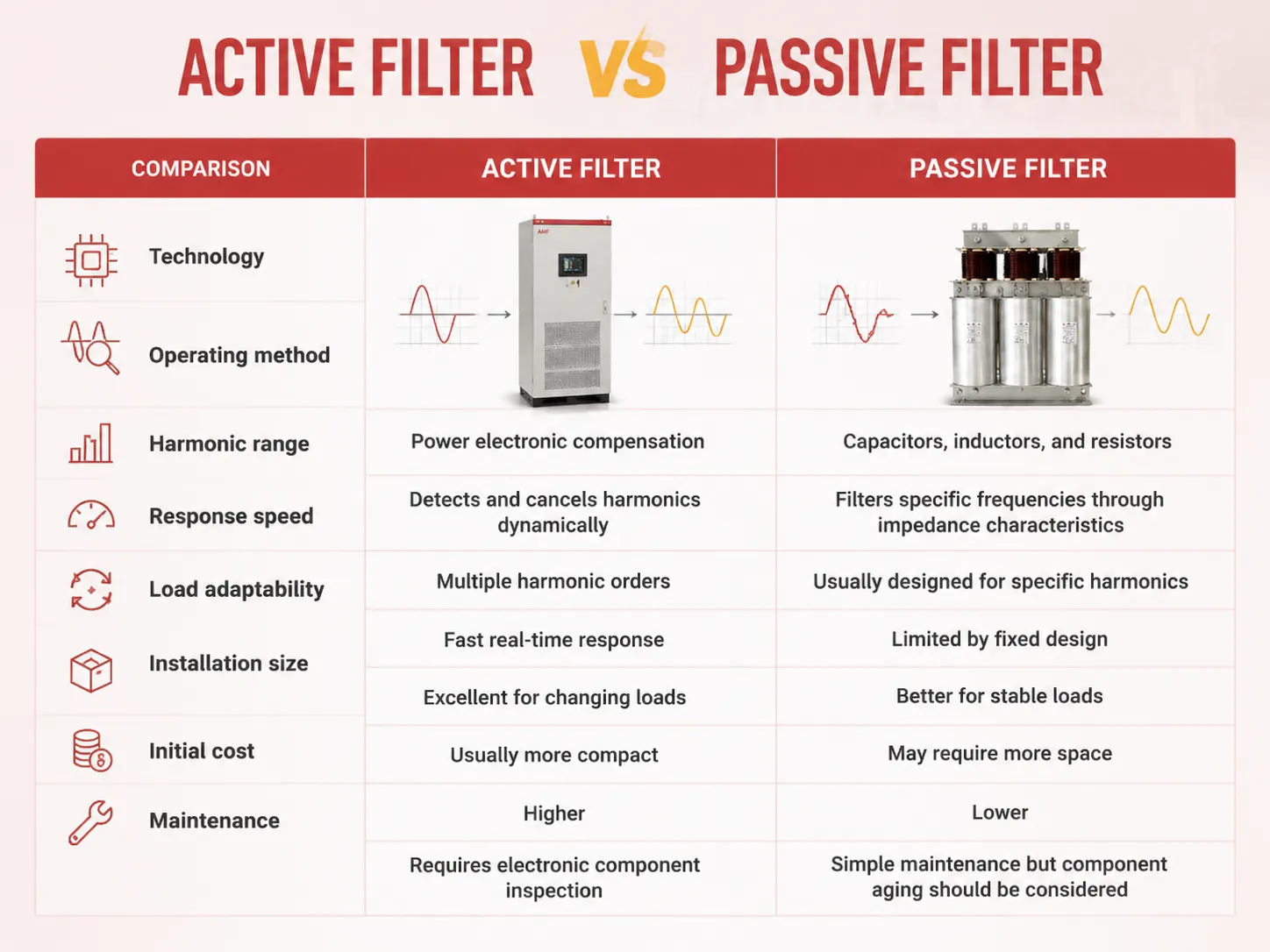
Although both active filters and passive filters are used for harmonic reduction, their technologies and performance characteristics are very different.
| Comparison | Active Filter | Passive Filter |
|---|---|---|
| Technology | Power electronic compensation | Capacitors, inductors, and resistors |
| Operating method | Detects and cancels harmonics dynamically | Filters specific frequencies through impedance characteristics |
| Harmonic range | Multiple harmonic orders | Usually designed for specific harmonics |
| Response speed | Fast real-time response | Limited by fixed design |
| Load adaptability | Excellent for changing loads | Better for stable loads |
| Installation size | Usually more compact | May require more space |
| Initial cost | Higher | Lower |
| Maintenance | Requires electronic component inspection | Simple maintenance but component aging should be considered |
Active Filter vs Passive Filter Applications
Where Are Active Filters Used?
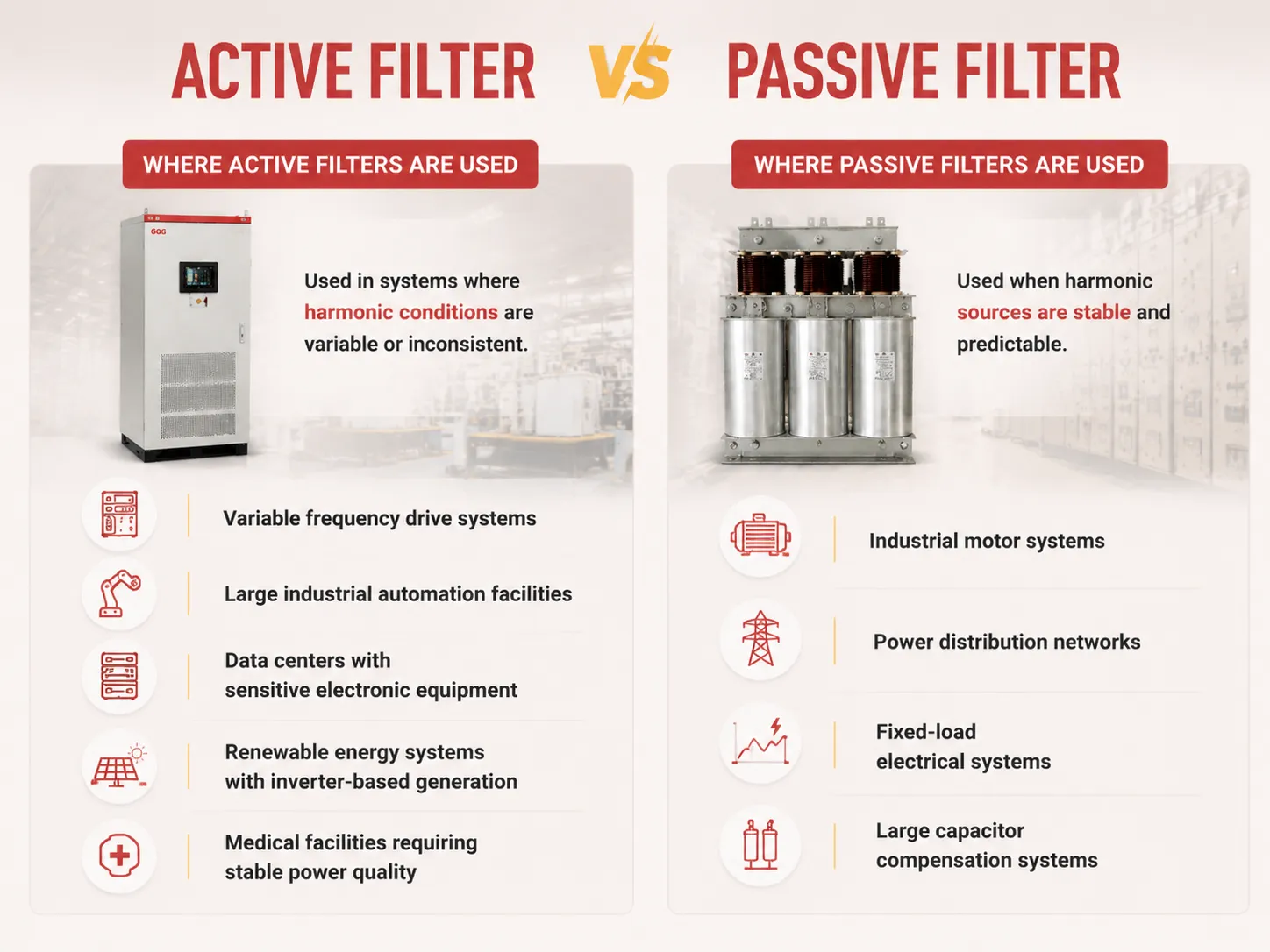
In general, active filters are employed in electrical systems where the nature of harmonic conditions can be variable or inconsistent.
For instance, a factory may be running several machines at different hours of the day. The harmonic content generated during the working hours of the plant may be different from those produced during the night shift.
In such cases, the active filter can change its level of compensation automatically without needing to have any system changes.
Common applications include:
- Variable frequency drive systems
- Large industrial automation facilities
- Data centers with sensitive electronic equipment
- Renewable energy systems with inverter-based generation
- Medical facilities requiring stable power quality
Where Are Passive Filters Used?
Passive filters are commonly used when harmonic sources are stable and predictable.
For instance, a company using a significant fixed-speed motor system could have a uniform harmonic pattern. In this scenario, a properly designed passive filter can offer a cost-effective solution.
Typical applications include:
- Industrial motor systems
- Power distribution networks
- Fixed-load electrical systems
- Large capacitor compensation systems
Why Harmonic Filtering Is Important
Harmonic distortion may appear to be a small electrical problem, however, having too many harmonics can lead to bigger issues eventually.
Common effects include:
- Overheating of transformers and cables
- Reduced equipment efficiency
- Unexpected equipment failures
- Interference with sensitive electronic devices
- Higher energy losses
Organizations like the Institute of Electrical and Electronics Engineers (IEEE) offer guidelines on power quality and harmonics control, giving engineers the tools needed for designing better electrical systems.
Advantages of Active Filters
Active filters are growing rapidly in importance in modern electrical systems, thanks to their capability to provide both flexible and smart harmonic compensation. One of the biggest advantages of active filters is that they are adaptable to changes in the electrical environment.
Real-Time Harmonic Compensation
One of the benefits of active filter is that it does not have a default design. It is constantly tracking the electrical system, thus allowing the filter to change its compensation according to the real operating situation.
This characteristic adds to the importance of active filters in installations where load conditions change frequently like manufacturing facilities, data centers, and commercial buildings.
Ability to Reduce Multiple Harmonic Frequencies
Passive filters are typically designed to target specific harmonic frequencies, while active filters allow compensation for multiple harmonic orders at the same time.
This is significant in present-day electric networks wherein various kinds of electrical devices can generate diverse harmonic issues.
Compact Installation Design
Active filters typically consume less space than many systems of passive filters. As a result, the active filtering device may be used in locations with next to no room for electrical installations.
Additional Power Quality Functions
An array of active filter systems can offer various other functions apart from harmonic reduction which includes reactive power and neutral current compensation along with load balancing.
Disadvantages of Active Filters
Though active filters work very well, they have some drawbacks that must be taken into account prior to installation.
- Higher initial investment: Active filters use advanced power electronics, which results in them being more costly than conventional passive solutions.
- More complex technology: Installation requires correct system analysis, sizing, and commissioning.
- Electronic component maintenance: The service life depends on the quality of internal power electronics and operating environment.
Advantages of Passive Filters
Passive filters are still a viable solution for many circuits due to their simplicity and cost-effectiveness.
Lower Installation Cost
One major benefit of passive filters is their minimal upfront expense. In situations where harmonics problems can occur, these filters deliver dependable performance without making a large investment.
Simple Structure and Maintenance
Since passive filters don’t employ complicated management systems, and electronic parts, their design is quite easy and maintenance needs remain minimal.
Low Operating Loss
In general, the operating losses of passive filters are minimal, which makes such filters more appropriate for applications in which harmonic conditions stay constant for long periods of time.
Disadvantages of Passive Filters
Passive filters have their advantages in specific situations, but they are not as versatile as the active ones.
- Limited harmonic range: The design of the product caters to different harmonic frequencies despite not handling changing harmonic conditions efficiently.
- Possible resonance problems: Incorrect design may create resonance between the filter and the electrical network.
- Less adaptable: Future changes in electrical loads may reduce filtering performance.
Active Filter vs Passive Filter: Price Comparison
Cost is one of the most important factors when selecting a harmonic filtering solution. However, the cheapest option is not always the most economical choice in the long term.
| Cost Factor | Active Filter | Passive Filter |
|---|---|---|
| Equipment cost | Higher due to power electronics and control systems | Lower due to simple component design |
| Installation space | Usually requires less space | May require larger installation areas |
| Maintenance | Requires electronic system inspection | Generally simple maintenance |
| Long-term flexibility | Excellent for future system changes | Limited when loads change |
For a stable electrical system with predictable harmonic sources, a passive filter may provide better economic value. For facilities where downtime, power quality, and future expansion are important, an active filter may provide better long-term benefits.
How to Choose Between Active Filter and Passive Filter?
In order to select the right active or passive filter, it is important to establish the specific requirements of the electrical system. There is not one approach which is most appropriate in every circumstance.
1. Analyze the Harmonic Problem First
Before choosing any filter, engineers must determine the existing power quality conditions, which include investigating the harmonic levels, the load characteristics, and system requirements.
Selecting incorrect filter kinds without conducting an adequate analysis can negatively affect performance and incur extra expenses.
2. Consider Load Changes
Ask whether the electrical load remains stable or changes frequently.
If there are variable loads in the system, such as VFDs, automation devices, or renewable energy converters, an active filter is typically preferred since it can react dynamically.
3. Evaluate Required Harmonic Performance
Applications having strict power quality demands get improved performance with active filters since these can provide better harmonic compensation.
In situations where only one or two specific harmonic issues are present, a passive filter could be adequate.
4. Consider Future Expansion
The electrical system may present changes over time. The introduction of new equipment, extra production lines, or new electrical machines may lead to the emergence of new sources of harmonics.
If future expansion is expected, an active filter provides greater flexibility.
Active Filter vs Passive Filter: Which One Should You Choose?
Selecting between an active and passive filter is primarily based on what the needs of your application are.
An active filter is usually the better choice when you need:
- Dynamic harmonic compensation
- High power quality performance
- Support for changing electrical loads
- Compact installation solutions
A passive filter is usually more suitable when you need:
- A cost-effective harmonic reduction solution
- Simple system design
- Stable and predictable operation
- Filtering for specific harmonic frequencies
Both alternatives have their own strengths. The appropriate technology will be determined by the electrical measurements, project specifications, and operational objectives.
Frequently Asked Questions About Active Filter vs Passive Filter
What is the main difference between active filter and passive filter?
The key distinction lies in how harmonics are eliminated. Followings are:
#Active filter— active filters use power electronics to identify and cancel harmonic currents dynamically.
#Passive filter— passive filters work by making use of capacitors and inductors to absorb specific harmonic frequencies
Are active filters better than passive filters?
It is not true that active filters are necessarily a better option. Active filters are able to provide flexibility and efficient operation in complex electric systems, while passive filters can be more cost-effective in fixing stable systems where harmonic sources are known.
Can a passive filter reduce all harmonics?
No. Typically, passive filters are engineered to filter a limited range of harmonic frequencies. The success of the passive filter relies on the accurate analysis of the electrical system and proper filter configuration.
How long do active filters and passive filters last?
The longevity of a filtering system relies on the conditions under which it is used, how well it has been installed, and maintained. Filtering equipment that has been properly fitted and maintained can ensure operations for many years to come.
References and External Resources
- IEEE — Provides technical standards and research resources related to electrical power quality and harmonic control.
- Schneider Electric — Global electrical equipment manufacturer providing power quality solutions and harmonic mitigation technologies.
- Eaton — Provides electrical protection and power management solutions for industrial and commercial applications.
- ABB — Develops electrical products and power quality solutions used in industrial and energy applications.
- National Electrical Manufacturers Association (NEMA) — Provides industry information and standards related to electrical equipment.
Conclusion
Understanding the difference between active filter vs passive filter is essential when selecting the right harmonic reduction solution. While both technologies help improve power quality, they are designed for different electrical environments.
Active filters provide intelligent, real-time compensation and are ideal for modern systems with changing loads and strict power quality requirements. Passive filters remain a reliable and economical choice for stable applications where specific harmonic problems need to be controlled.
Before choosing a harmonic filter, engineers should evaluate the electrical system, analyze harmonic conditions, consider future expansion, and compare the total cost of ownership. Selecting the right filtering solution can improve equipment reliability, reduce power quality problems, and create a safer and more efficient electrical system.