

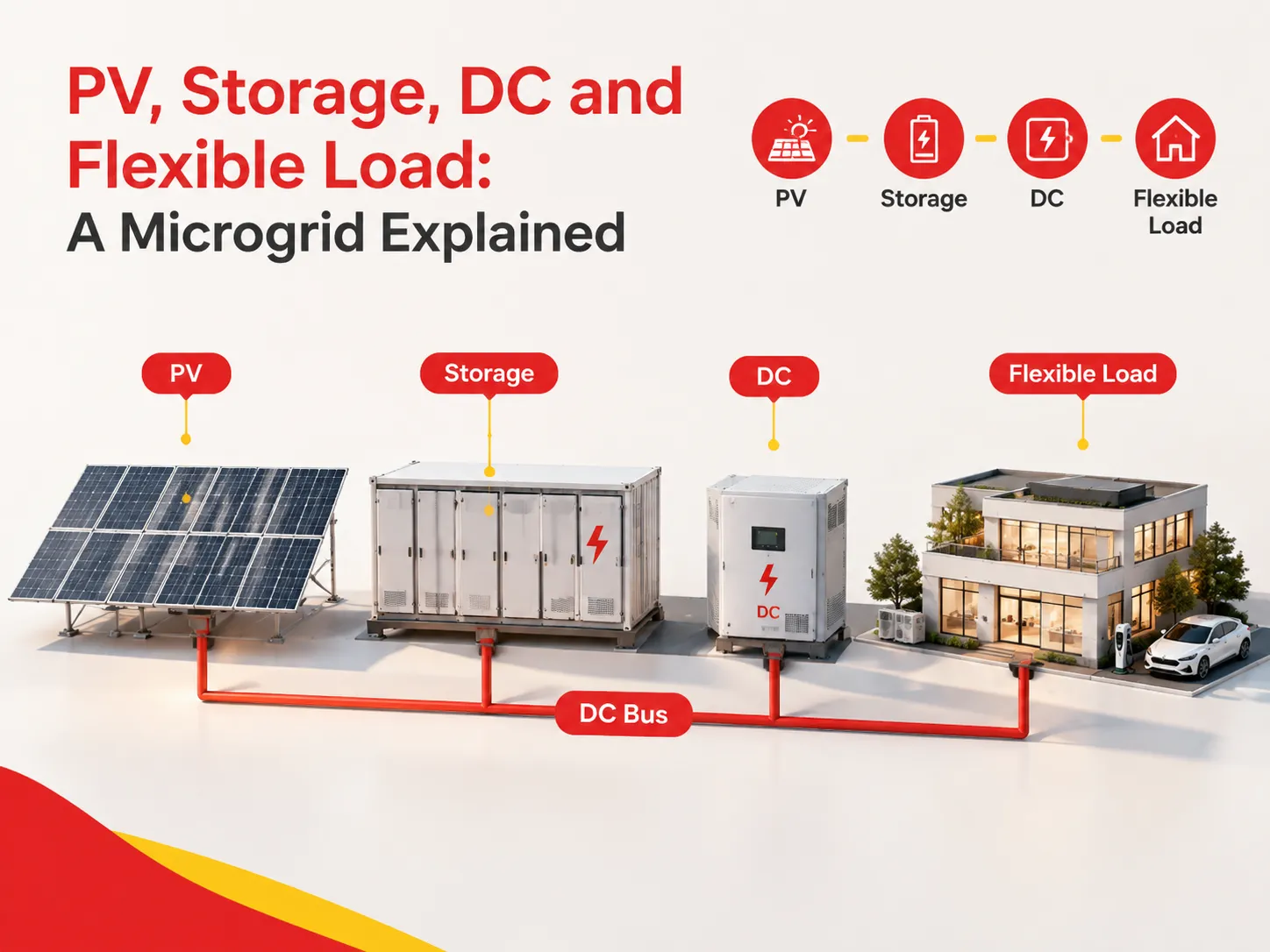
The phrase “PV-storage-DC-flexible microgrid” gets used as if it describes one product. It describes four subsystems that happen to share a busbar, and each one is a design decision in its own right. Getting the four to cooperate is where the engineering effort goes.
Here is what each part does, what hardware sits behind it, and where the whole arrangement is worth the complexity.
The Four Parts, in Plain Terms
- PV generates direct current, and it generates it whether or not anyone needs it at that moment.
- Storage moves energy in time, absorbing the surplus and releasing it later.
- DC distribution is the busbar both of them connect to, and it feeds loads that also want DC.
- Flexible is the control layer that ties the busbar to the AC grid and decides what happens when the two disagree.
1. PV: 600 to 1500 V of Direct Current
Monocrystalline, polycrystalline PERC and bifacial modules all produce direct current at string voltages typically between 600 V and 1500 V. A DC/DC converter with maximum power point tracking boosts that to the bus voltage and holds the array at its best operating point as irradiance and temperature change through the day.
The array also needs a combiner and protection cabinet: string fusing, surge protection, isolation, and the monitoring that tells you a string has gone open before someone notices a dip in generation three weeks later.
The detail that matters for the rest of the system is that PV output is DC already. In a conventional AC-coupled design it gets inverted to AC and then rectified back to DC at the load, and both conversions cost efficiency. On a DC bus, those two conversions disappear.
2. Storage: Batteries, a BMS, and Two-Way Converters
Lithium iron phosphate is the mainstream chemistry for stationary storage: good cycle life, thermally stable, and predictable. Supercapacitors cover the very short, very high power events, and flow batteries remain the option for long duration where the space exists.
The pack is only half the system. A battery management system tracks cell voltage, temperature and state of charge, balances the cells and enforces the limits that keep the pack from becoming a fire risk. A bidirectional DC/DC converter links the pack to the bus and allows energy to flow in both directions, which is what makes peak shaving and solar smoothing possible.
The storage control cabinet handles protection, thermal management and the continuous reporting of SOC and SOH. Those two numbers are what the energy management system uses to decide whether the battery can take another charge cycle this afternoon.
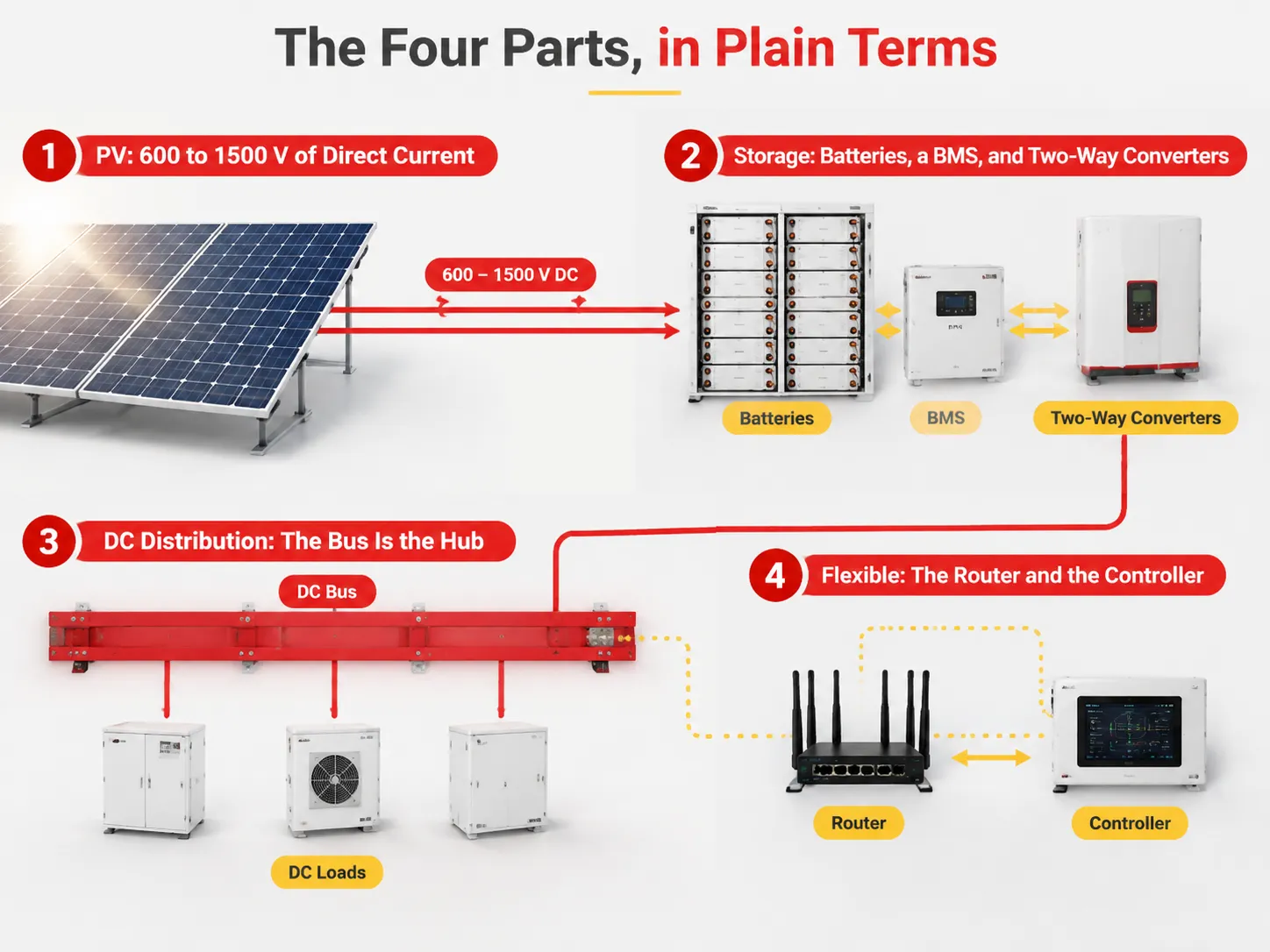
3. DC Distribution: The Bus Is the Hub
Common bus voltages are ±375 V, 750 V and 1500 V, chosen to match the PV string voltage, the battery pack voltage and the load characteristics. The DC distribution cabinet handles power allocation, circuit protection and metering.
From the bus, step-down DC/DC modules produce the low voltages that loads actually use: 24 V, 48 V, 220 V DC. Typical DC loads include LED lighting, DC air conditioners, EV chargers and IT equipment in data halls.
Supplying those loads directly from DC avoids a rectifier per load. In a building with hundreds of LED drivers and dozens of small power supplies, that is not a marginal saving. It is the main efficiency argument for the architecture.
4. Flexible: The Router and the Controller
The flexible bidirectional converter is the interface between the DC bus and the AC world. It converts in both directions, supports a seamless transition between grid-tied and islanded operation, and isolates faults quickly enough that the rest of the microgrid does not see them.
Above it sits the microgrid central controller (MGCC), which runs the energy management strategy: how much to charge, when to discharge, which loads to shed, when to export. The EMS platform provides the monitoring, data logging, strategy tuning and remote maintenance that make an unmanned site practical.
The fourth element is the flexible load itself. Adjustable air conditioning, thermal storage, V2G-capable chargers and controllable industrial loads can all shift their consumption in response to a signal. A microgrid with flexible loads needs less battery than one without, because it can move demand instead of storing supply.
The Supporting Cast
A working system also needs grid-tied inverters, integrated AC/DC backup supplies, power quality monitors, fault recorders and anti-islanding protection. These are the parts nobody specifies in the first meeting and everybody needs by commissioning, particularly anti-islanding: an inverter that keeps energising a dead grid is a hazard to the crew working on it.
Power quality monitoring deserves a mention on its own. A DC microgrid still connects to an AC grid through converters, and those converters have their own harmonic and reactive signature. Where the grid interface is weak, an integrated power quality controller at the point of connection covers voltage and current quality together rather than as two separate retrofits.
How the Pieces Connect
PV feeds the DC bus through MPPT DC/DC converters. Storage connects to the same bus through bidirectional converters. The bus supplies local DC loads through step-down converters. The flexible converter bridges the bus to the utility supply and to AC loads. Everything is scheduled by the central controller, which is the only device with a view of the whole system.
Two design questions decide most of the cost. First, where the bus voltage sits, because that fixes the converter ratios and the protection ratings. Second, how much of the load is DC-native, because that determines whether the efficiency gain justifies the architecture.
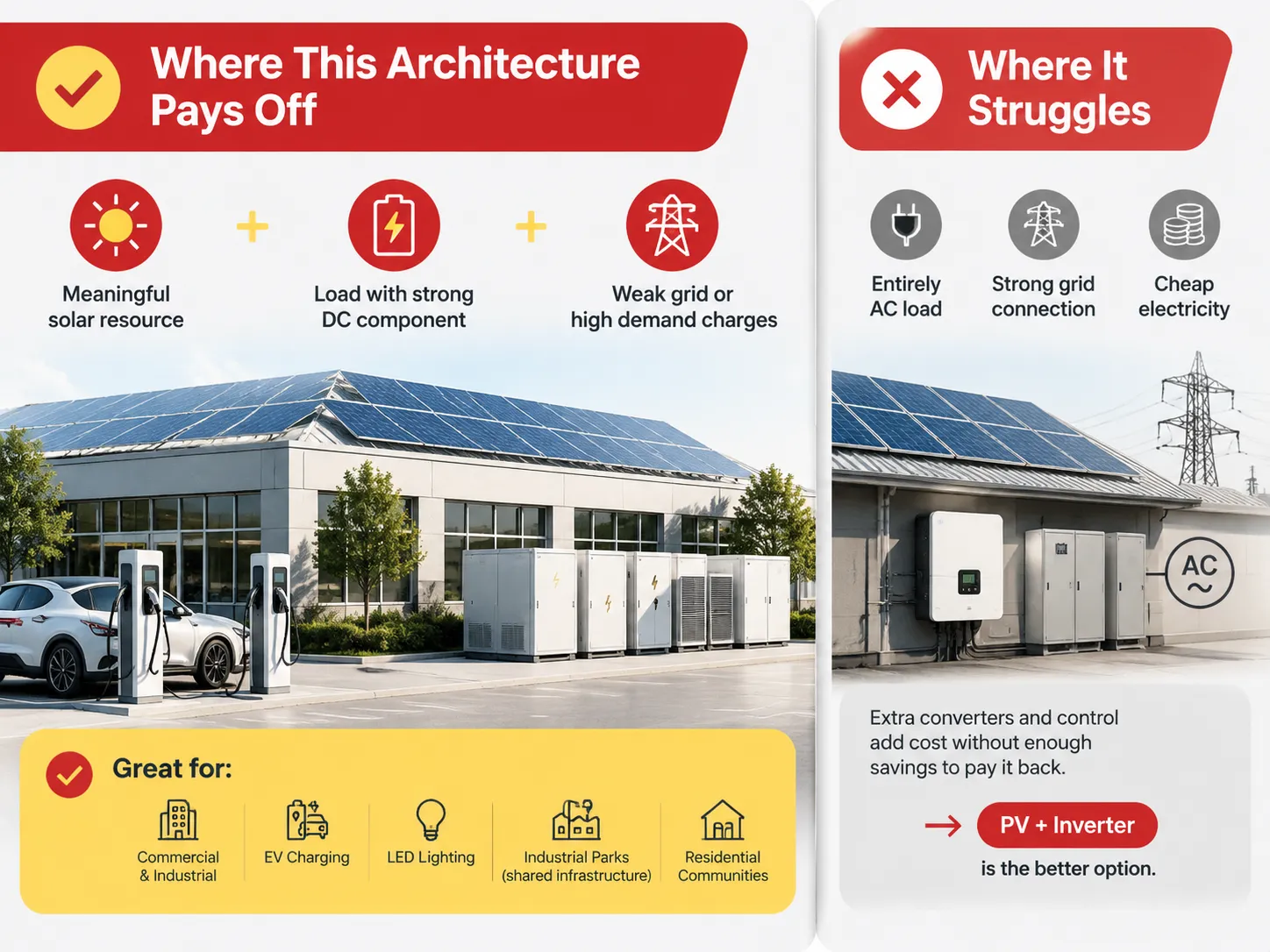
Where This Architecture Pays Off
The economics work best where three things are true at once: a meaningful solar resource on the roof, a load with a strong DC component, and either a weak grid connection or a demand charge that rewards peak shaving.
Commercial and industrial sites with rooftop PV, EV charging and LED lighting fit that description well. So do industrial parks with shared infrastructure and residential communities with community-scale storage.
Where it struggles is a site with an entirely AC load, a strong grid connection and cheap electricity. There the extra converters and the controls layer add cost without removing enough conversions to pay it back, and a conventional PV-plus-inverter installation is the better answer.
FAQ
Does a DC microgrid need batteries?
Strictly, no. A DC bus can run from PV and the grid interface alone. In practice, storage is what makes the bus stable and what allows islanded operation, so most designs include it.
Can I add this to an existing building?
In stages, yes. PV and storage can be added on the AC side first, then a DC bus introduced for new loads. Retrofitting DC distribution to existing AC circuits is rarely worth it; designing new circuits for it usually is.
What happens during a grid outage?
The flexible converter opens the grid interface and the microgrid continues in island mode, with the storage and PV carrying priority loads. The transition is fast enough for most equipment, though not for everything, so critical loads still warrant local ride-through.
Is the safety profile different from AC?
Yes. DC arcs do not self-extinguish at a current zero crossing, so protection devices must be DC-rated and the installation needs DC-specific isolation and labelling. Anyone working on the bus should be trained for it.