


In certain industries, electrical equipment is working without interruption 24 hours a day. Motors, pumps, compressors, welding machines, and other inductive loads require a significant amount of reactive power, which negatively affects energy efficiency and increases electricity bills. In some regions, companies may incur additional fees from electricity providers due to bad power factor.
In order to address this issue, numerous manufacturing plants and commercial structures employ an automatic power factor controller, also called an APFC.
To put it simply, automatic power factor controllers are intelligent control devices designed for the automatic firm management of capacitor banks to optimize the power factor of an electrical system. They are capable to sense changes in reactive power demand and turn on/off capacitors whenever necessary.
This article discusses the meaning, function, significance, application, price, and selection of the appropriate automatic power factor correction for an electric system.
What Is an Automatic Power Factor Controller?
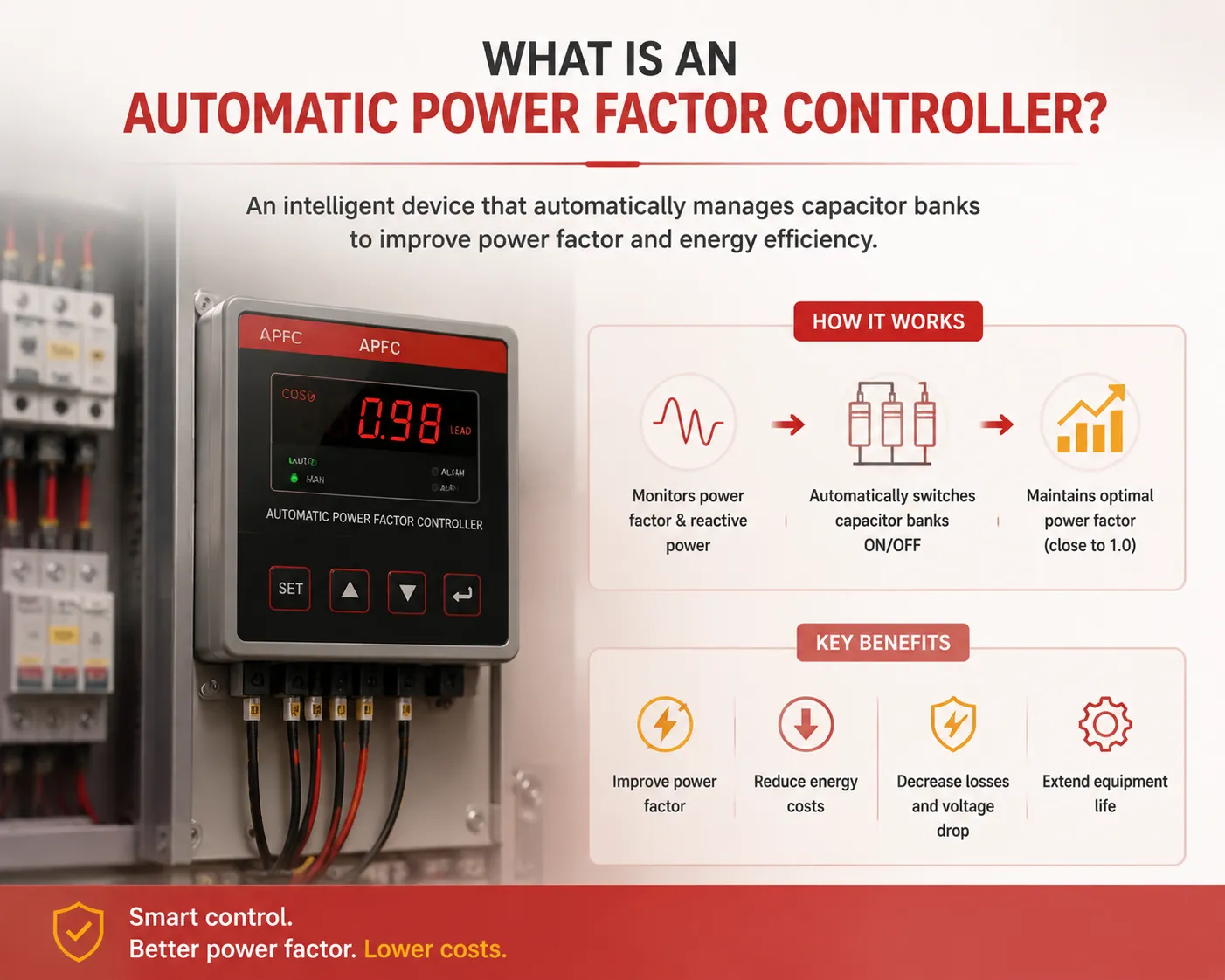
A power factor automatic controller is a device that automatically adjusts and regulates power factor of a system electrically.
This management unit belongs to an automatic regulator of power factor. This supervisor supervises the power factor value for electricity consumption and manages capacitor batteries according to the current demand for reactive energy.
In case of low power factor, the APFC controller connects extra capacitors for reactive power compensation. When there is an improved power factor or reduced load, the controller disconnects the unnecessary capacitors.
AFC controllers essentially serve as smart managers of capacitors, ensuring more effective use of electricity in the system.
What Is Power Factor and Why Does It Matter?
Before understanding a Power Factor Controller, it is important to understand power factor itself.
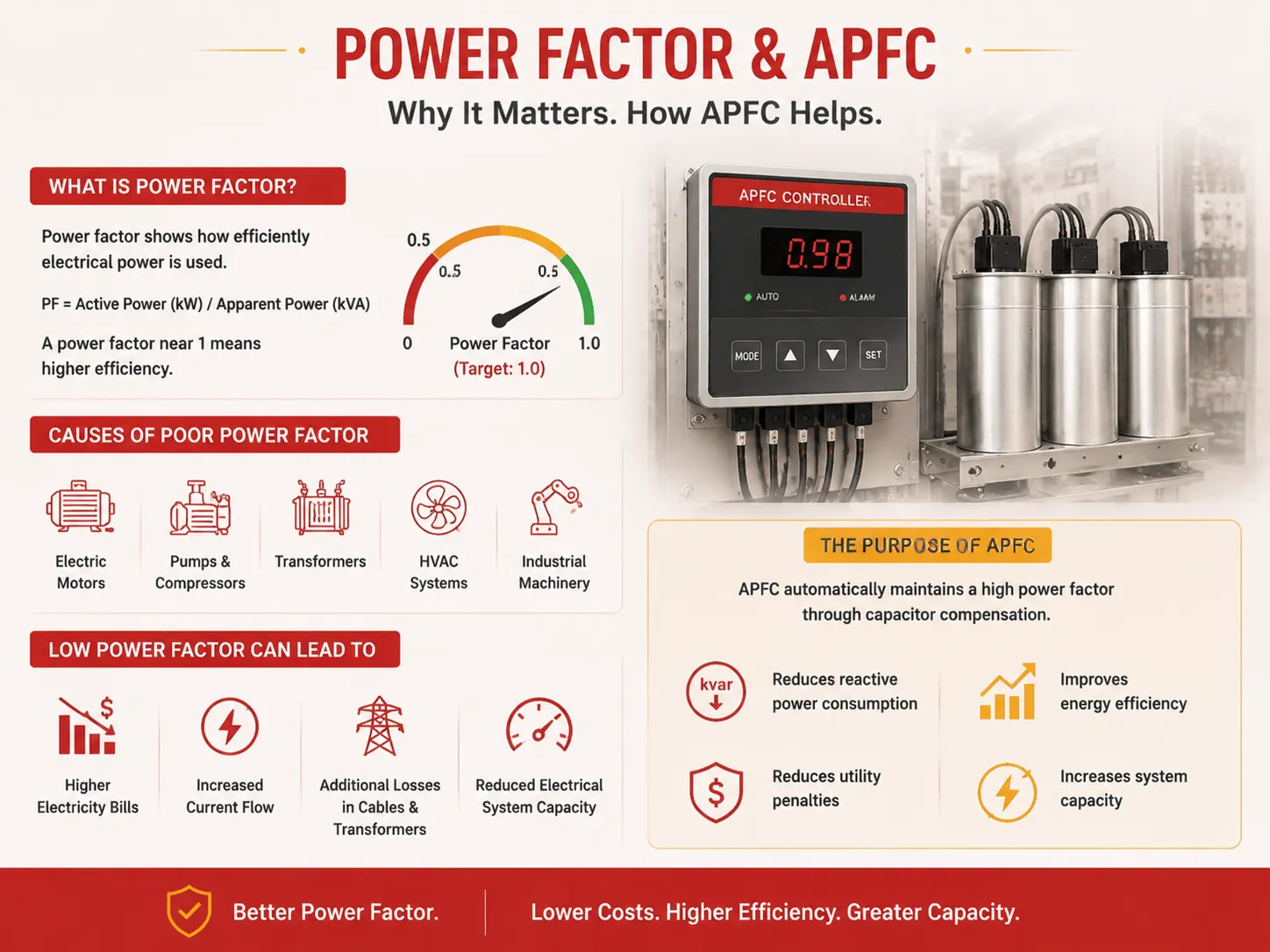
Power factor shows how efficiently electrical power is used. It represents the ratio between active power (kW) and apparent power (kVA).
An electrical system that has a power factor near to 1 is considered to be efficient. With a lower power factor the amount of current that needs to be used would increase.
Poor power factor is usually caused by inductive loads such as:
- Electric motors
- Pumps and compressors
- Transformers
- HVAC systems
- Industrial machinery
A low power factor can result in:
- Higher electricity bills
- Increased current flow
- Additional losses in cables and transformers
- Reduced electrical system capacity
What Is the Purpose of APFC?
The main purpose of the APFC (Automatic Power Factor Correction) system is to maintain a high power factor through capacitor compensation automatically.
The APFC controller keeps an eye on electrical conditions and does the adjustment automatically rather than switching capacitors manually.
The main benefits include:
- Reducing reactive power consumption: The system compensates for unnecessary reactive power demand.
- Improving energy efficiency: Electrical equipment operates more efficiently with optimized power usage.
- Reducing utility penalties: Many industrial customers can avoid poor power factor charges.
- Increasing system capacity: Lower current demand helps improve the available capacity of electrical infrastructure.
How Does an Automatic Power Factor Controller Work?
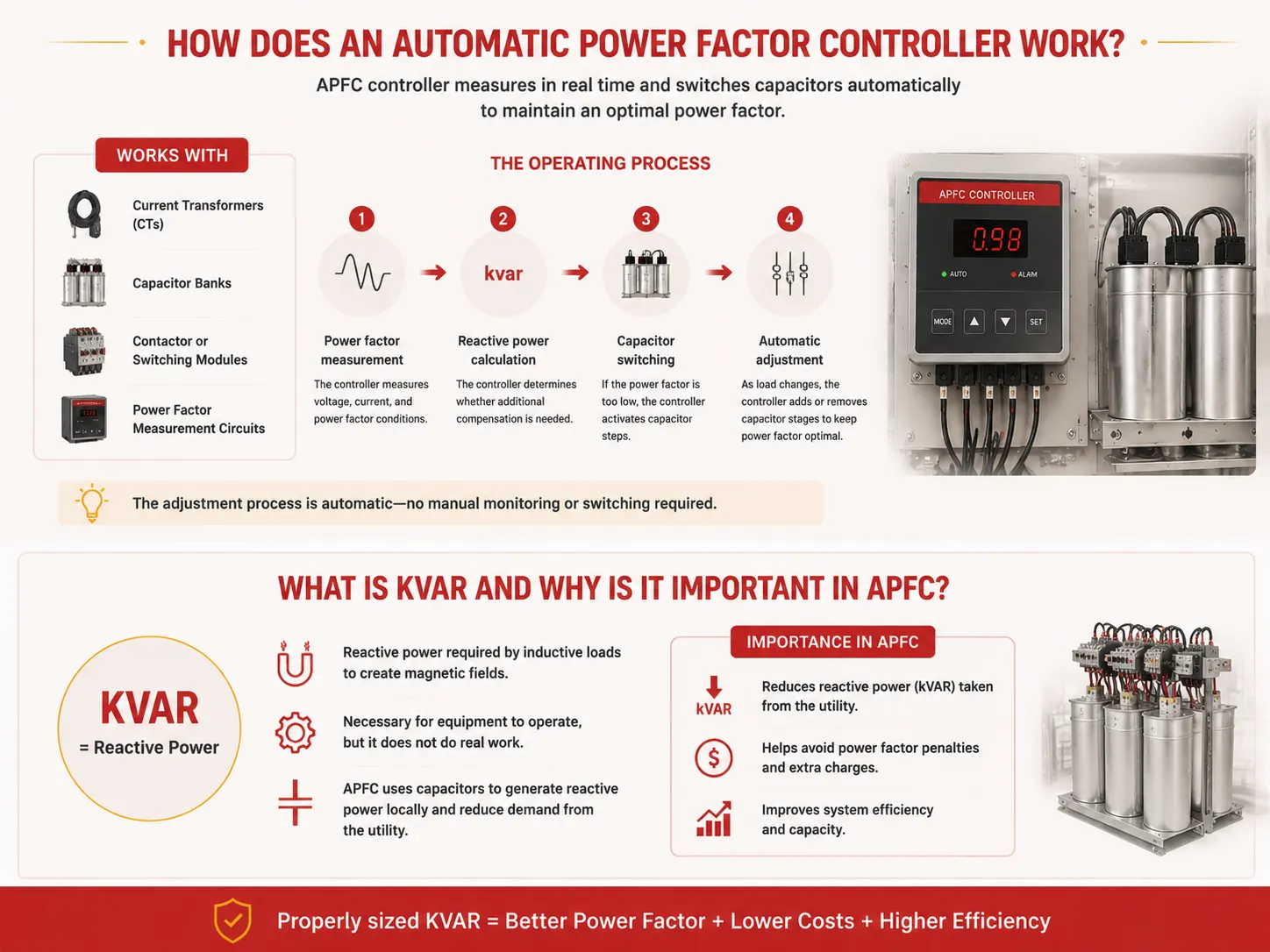
Automatic power factor controller functions based on the real-time measurement and switching of capacitors automatically.
The APFC controller usually works together with:
- Current transformers (CTs)
- Capacitor banks
- Contactor or switching modules
- Power factor measurement circuits
The operating process is as follows:
- Power factor measurement:
The controller measures voltage, current, and power factor conditions in the electrical system. - Reactive power calculation:
The controller determines whether additional reactive power compensation is needed. - Capacitor switching:
If the power factor is too low, the controller activates capacitor steps to provide compensation. - Automatic adjustment: In the event of a change in load, the controller either adds or removes capacitor stages to ensure power factor to be maintained.
Because the adjustment process is done automatically, operators are not required to observe electrical loads or change the capacitor banks separately.
What Is KVAR and Why Is It Important in APFC?
KVAR represents reactive power, which is the type of electrical power that is required by inductive appliances in order to create magnetic field.
For machinery to function, reactive energy is necessary, but reactive energy does not provide practical work.
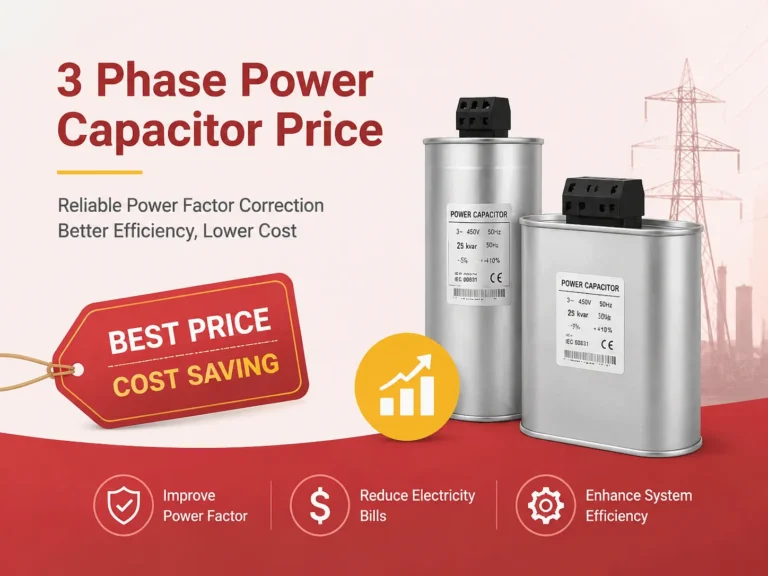
The installation of an APFC system incorporates the use of capacitors to produce some reactive power at its source, thus lessening the level of reactive power taken from the electric utility.
Capacitors are typically expressed in KVAR. A properly sized KVAR system enables to minimize power factor costs.
Main Components of an Automatic Power Factor Correction System
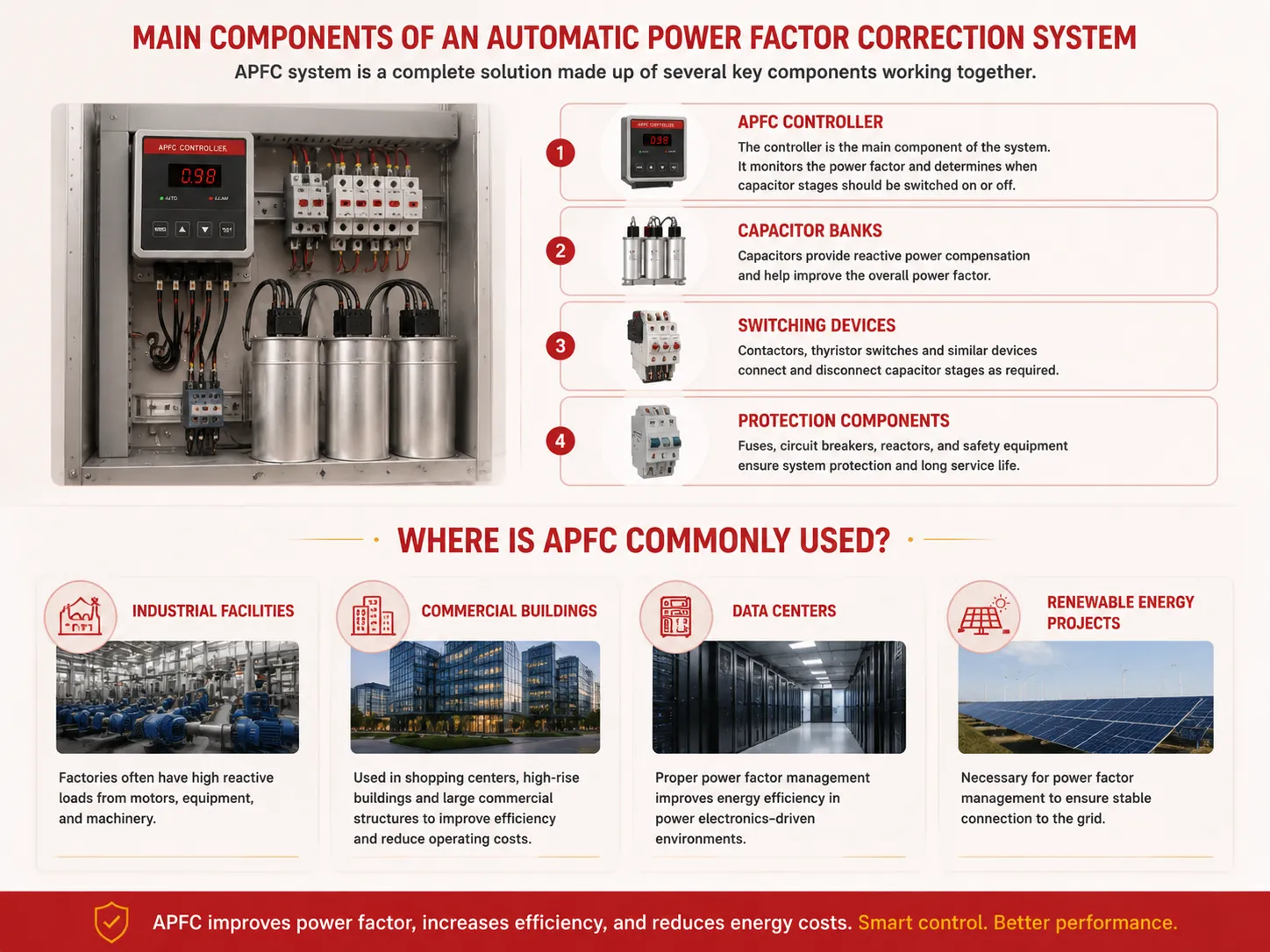
APFC system is not just a control device. It is a whole package that consists of many important parts.
APFC Controller
The controller is the main component of the system. It monitors the correct power factor and determines when the correspondent circuit stages should be switched on or off.
Capacitor Banks
Capacitors provide reactive power compensation and help improve the overall power factor.
Switching Devices
The contactors, thyristor switches and similar devices are expected to connect and disconnect from the capacitor stage as the controls demand.
Protection Components
Fuses, circuit breakers, reactors, and safety equipment contribute to safety and prolong system lifespan.
Where Is APFC Commonly Used?
Automatic power factor regulators are utilized in places where electrical loads have high quantities of reactive power.
Industrial Facilities
Factories are among the most commonly used industries. Power factor problems are often related to motors, distilling appliances, and machinery.
Commercial Buildings
APFC systems are employed in shopping centers, high-rise buildings and big commercial structures to improve their power efficiency and regulate operating costs.
Data Centers
Proper power factor management is essential for achieving energy efficiency, even though modern data centers primarily work with devices that use the power electronics approach.
Renewable Energy Projects
There are requirements for power factor management in solar power plants and other renewable energy systems so that the connection to the GRID can be accomplished.
Advantages of Automatic Power Factor Controller
An automatic power factor controller has multiple advantages over the manual methods of power factor correction, and the most significant advantage is that the automatic controller is capable of changing and adjusting to the varying electrical loads to ensure that the power factor remains stable.
Automatic Reactive Power Compensation
The primary benefit of APFC controller is that it makes necessary adjustments to capacitor banks in real time according to power demand. This helps in preventing over or under compensation.
In installations with varying loads, automatic adjustment technology is superior to its manual counterpart.
Reduced Electricity Costs
Many areas are faced with extra fees imposed by power companies due to low power factor problems. However, an APFC solution can be useful since it can ensure a higher factor and eliminate any reactive power expenses.
Energy savings and the reduction in penalties can turn APFC installation into an important long-term investment for big industrial users.
Improved Electrical System Efficiency
A decrease in reactive power requirement leads to reduced current loading of electrical appliances such as transformers, cables, and distribution systems.
This can enhance system efficiency and maximize the use of available capacity without replacing existing power systems.
Better System Stability
PFC or automatic power factor controller improves stability of electrical parameters by continuously adjusting the level of compensation.
Limitations of Automatic Power Factor Controller
While there are various advantages of the APFC device, improper designing makes it inappropriate for certain situations.
- Requires correct sizing: Incorrect capacitor capacity selection may lead to poor performance or overcompensation.
- Initial investment: The cost is higher than simple manual capacitor switching solutions.
- Maintenance requirements: Capacitors, switching devices, and protection components require periodic inspection.
- Harmonic considerations: In tension or current systems which have excessive harmonic distortion, it may become necessary to install reactors that will help to minimize the distortion.
Automatic Power Factor Controller Brands and Manufacturers
The market provides various APFC and power factor correction products from foreign manufacturers of electric equipment. The best option depends on project specifications, voltage output, capacity, and local technical support.
Some well-known manufacturers include:
Schneider Electric
Schneider Electric offers power control solutions and devices for power factor correction for industrial and commercial sectors. Their solutions have been extensively applied in the global electrical distribution systems.
ABB
ABB provides equipment for power quality, capacitive banks, and automatic power factor correction in accordance with industrial energy management.
Siemens
Siemens offers technologies for electrical distribution and power control used in factories, infrastructure projects, and commercial buildings.
Eaton
Eaton produces electrical equipment and power quality devices such as its reactive power compensation systems.
In order to choose the APFC provider, consumers must look not only if the brand is reputable but also their level of customer service, reliability, compatibility, and service.
How Much Does an Automatic Power Factor Controller Cost?
The cost of an automatic power factor controller depends on several factors, including controller type, capacitor capacity, voltage level, switching method, and manufacturer.
| Factor | Impact on Cost |
|---|---|
| Compensation capacity (KVAR) | Larger systems require more capacitor stages and higher investment |
| Voltage level | Low-voltage systems are usually less expensive than medium-voltage solutions |
| Switching technology | Thyristor switching systems usually cost more than contactor switching |
| Brand and features | Advanced controllers and premium brands may have higher prices |
In general terms, an automatic Power Factor Corrector controller for simple use may be priced around several hundred US dollars, while an industrial APFC panel, complete with capacitor banks and different protection components, may cost from several thousand to tens of thousands of dollars, depending on its capacity.
To arrive at the exact price, a supplier must possess the following information: system voltage, required KVAR compensation, existing power factor, and installation conditions.
How to Select the Right Power Factor Controller?
When selecting an appropriate Power Factor controller, one needs to go beyond just choosing a device with the needed number of capacitor stages, the condition of the electrical system must first be reviewed.
1. Check Existing Power Factor
Prior to choosing an APFC system, evaluate the current power factor. Knowing this information enables the calculation of reactive power compensation needed.
2. Calculate Required KVAR Capacity
The actual reactive power demand must be satisfied by the appropriate capacitor bank size. Compensation that is either oversized or undersized can decrease system effectiveness.
3. Consider Load Characteristics
Different electrical environments require different solutions.
For example:
- Stable industrial loads may use traditional contactor-based APFC systems.
- Rapidly changing loads may require fast switching technologies such as thyristor-based systems.
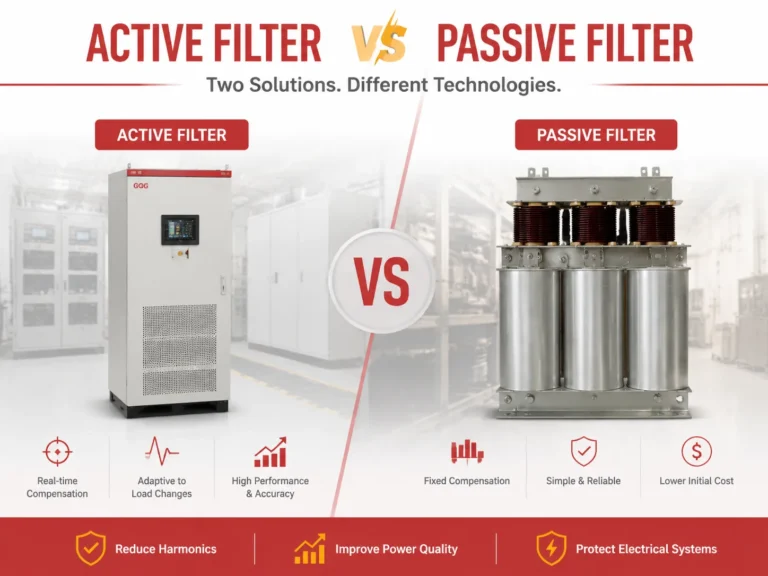
- High harmonic environments may require reactors or harmonic filtering solutions.
4. Check System Expansion Plans
If there might be any additional machinery or electrical gear that will need to be accommodated in the future, it would be valuable to have an expandable APFC option to ensure that upgrade costs are kept to a minimum.
Automatic Power Factor Controller vs Manual Power Factor Correction
| Feature | Automatic Power Factor Controller | Manual Power Factor Correction |
|---|---|---|
| Control method | Automatic adjustment | Manual switching |
| Response to load changes | Fast and continuous | Limited |
| Operator involvement | Minimal | Requires manual operation |
| Efficiency | Higher for variable loads | Suitable for stable loads |
Frequently Asked Questions About Automatic Power Factor Controller
How to use an automatic power factor controller?
The automatic power factor controller is placed inside the power factor correction panel and connected with the current transformers, capacitor banks, and switching devices. The controller first sets a target power factor value and automatically monitors the electrical system to switch capacitor stages according to the demand for reactive power.
What is the cost of automatic power factor controller?
The price is determined by the compensating capacity, power of the system, switching method, and whether the customer wants just a controller or a complete APFC panel. Small systems may cost hundreds of dollars, while big industrial ones can need higher investments.
What is the purpose of KVAR?
KVAR is an abbreviation of reactive power and helps to determine how much compensation is required in order to improve the power factor of electrical systems. Because capacitor banks supply compensation for reactive power, they are usually rated in KVAR.
Where is APFC commonly used?
APFC devices can be found in many places like industries, commercial complexes, malls, hospitals, renewable energy projects, etc., where electrical consumptions produce strong reactive power.
What is the purpose of APFC?
One of the objectives of an APFC is to keep a suitable power factor automatically through capacitor control. This device aids the decrease of reactive power utilized, improves energy efficiency, and enhances the performance of the electric network.
References and External Resources
- Schneider Electric — Provides power management, electrical distribution, and energy efficiency solutions.
- ABB — Offers power quality and reactive power compensation solutions for industrial applications.
- Siemens — Provides electrical infrastructure and industrial energy management technologies.
- Eaton — Develops electrical protection and power quality solutions for commercial and industrial users.
- U.S. Department of Energy — Provides information about energy efficiency and electrical system optimization.
Conclusion
An automatic power factor controller plays a significant role in improving the efficiency of electrical systems and controlling reactive power in contemporary power grid systems. An APFC device automatically manages capacitor banks thereby ensuring a stable power factor, reducing wasted energy costs, as well as enhancing the performance of equipment.
For industrial plants, commercial buildings, and large electrical installations, choosing the appropriate Power Factor Controller involves some careful consideration of the load characteristics, KVAR needs, existing conditions, and future growth.
The APFC system, if properly chosen and installed, can offer fixed, long-term advantages by enhancing power quality, increasing system performance, and ensuring better reliability of the electrical network.