

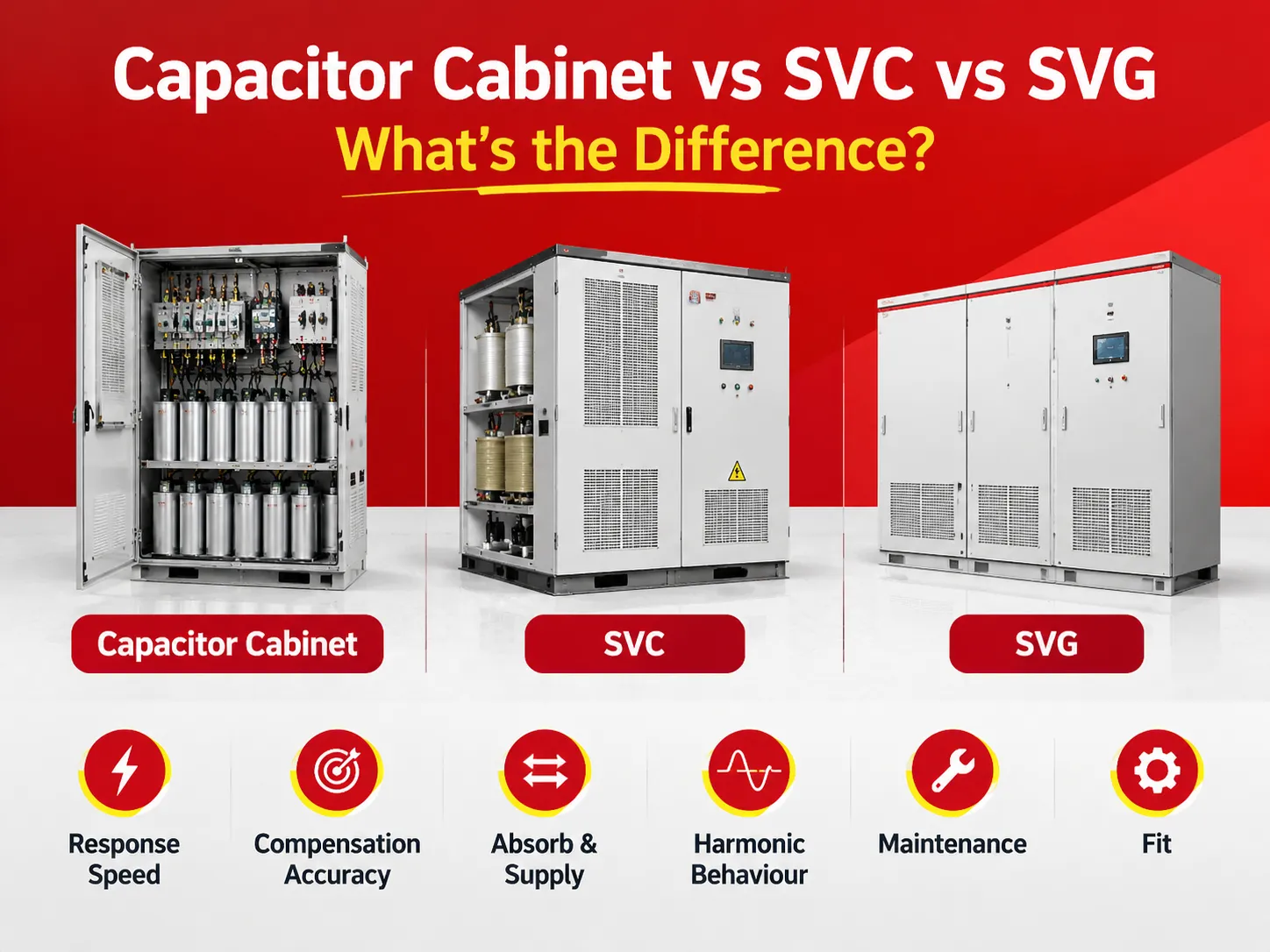
Three names come up in every reactive power conversation: capacitor cabinet, SVC and SVG. They are usually presented as a ladder, with the SVG at the top, and that framing causes as many bad specifications as it solves.
They are not three generations of the same product. They are three different ways of putting reactive power onto a busbar, and each one is the correct answer under different site conditions. What follows compares them on the six dimensions that actually decide a project: response speed, compensation accuracy, ability to absorb as well as supply, harmonic behaviour, maintenance, and fit.
What Each Solution Actually Is
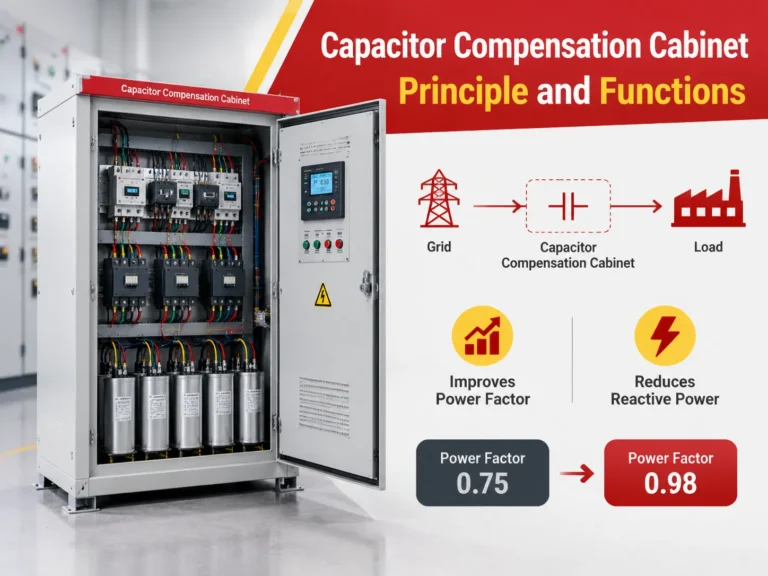
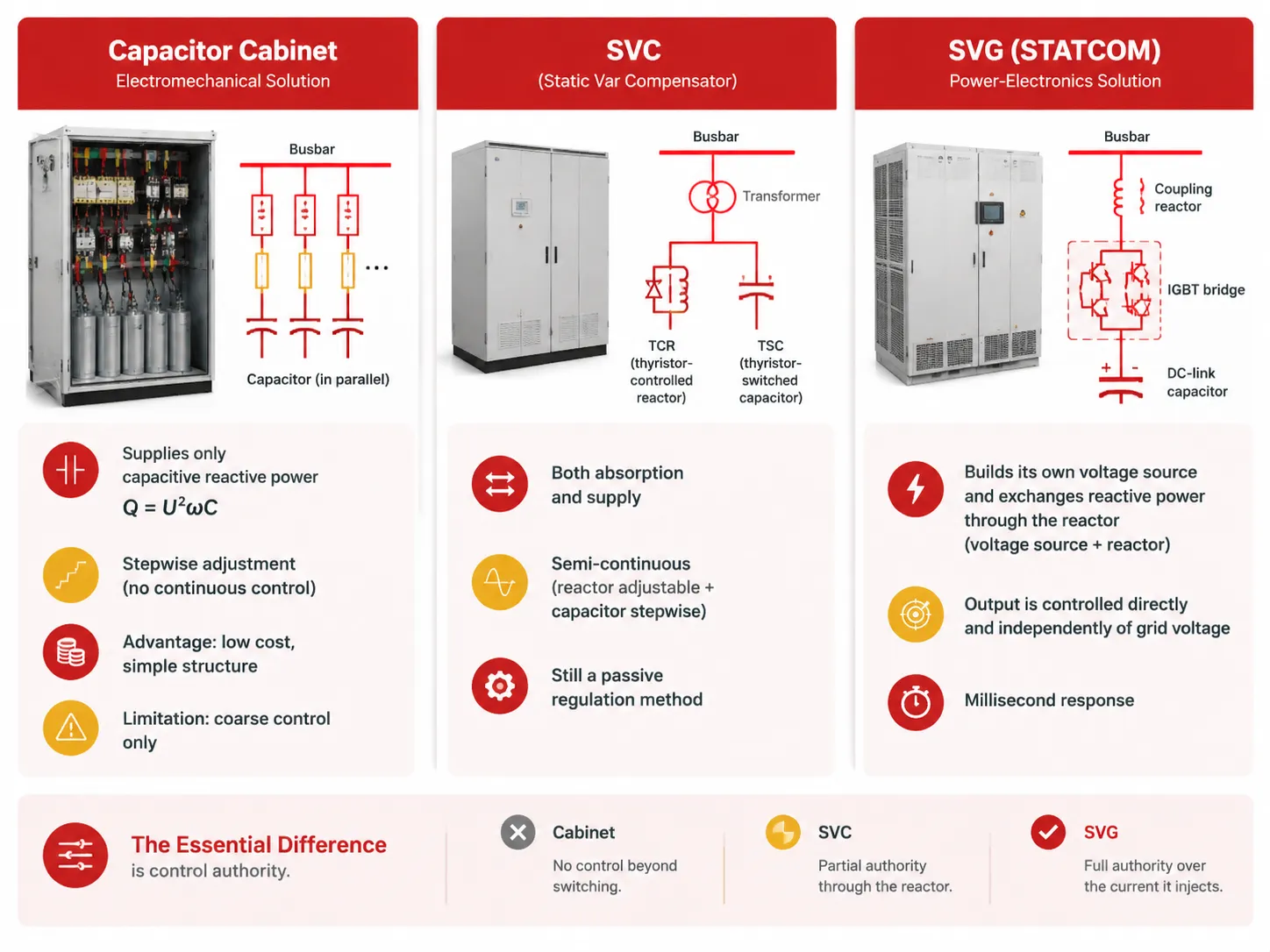
Capacitor cabinet. The traditional electromechanical solution. Contactors, fuses or cables, capacitor terminals, connected in parallel to the busbar and switched in groups. It can only supply capacitive reactive power, with output following Q = U²ωC. Adjustment is stepwise; there is no continuous control. Its advantage is cost and simplicity, its limitation is that “coarse” is the only setting it has.
SVC (static var compensator). The thyristor-controlled dynamic solution. A control panel, thyristor valves, a thyristor-controlled reactor (TCR), thyristor-switched capacitors (TSC) and usually a transformer. Phase-angle control makes the reactor current continuously variable while the capacitor branches switch in steps. The combination of adjustable reactor and switched capacitor gives it both absorption and supply. It is semi-continuous, and still fundamentally a passive regulation method.
SVG (static var generator, also called STATCOM). The power-electronics solution. An IGBT bridge, a DC-link capacitor and a coupling reactor. It builds its own voltage source and exchanges reactive power with the grid through the reactor: voltage source plus reactor, in short. Output is controlled directly and independently of grid voltage, and response lands in the millisecond range.
The essential difference is control authority. The cabinet has none beyond switching. The SVC has partial authority through the reactor. The SVG has full authority over the current it injects.
Response Speed: Why the Gap Is So Wide
The interesting part of this comparison is not who detects the change first. All three detect it almost instantly. The difference is how long it takes for the decision to become current in the busbar.
Capacitor cabinet. The output has to wait for a contactor to pick up and a capacitor to pre-charge, and controllers add a deliberate delay to avoid hunting between steps. Mechanical switching takes tens of milliseconds to seconds. The bottleneck is physical; the compensation is reliable, inexpensive and slow.
SVC. A thyristor can only fire after a forward voltage zero crossing, so each firing can be delayed by up to half a cycle, about 10 ms at 50 Hz. The TCR branch is continuous, but the TSC branches are still stepped. Call it half-cycle response, 10–20 ms.
SVG. The IGBT switches at kilohertz rates, so there is no waiting for a zero crossing. Detection, calculation and PWM output are all digital, and the current loop closes inside a switching period. Practically 1–10 ms, with the control loop itself running far faster.
Whether this matters depends entirely on the load. For a plant with slowly varying demand, all three perform about the same and the cheapest one wins. For arc furnaces, spot welders, crushers and press lines, the difference between 10 ms and 100 ms is the difference between catching the disturbance and reporting on it afterwards.
Compensation Accuracy: Why Banks Over- and Under-Compensate
Accuracy comes down to resolution. The reactive deficit should be matched by the compensation output, and any mismatch is under- or over-compensation.
Capacitor cabinet. A typical bank is configured 50 + 50 + 100 + 100 kvar, so the best it can do is match in 50 kvar steps. A load needing 70 kvar gets 50, which under-compensates. A load needing 130 gets 150, which over-compensates and pushes reactive power back onto the grid. Once the steps are fixed, the resolution is fixed.
SVC. The TCR gives continuously adjustable inductive output, and the TSC branches add capacitive steps. Overall output is close to continuous, limited by control resolution and by how the filter branches are configured.
SVG. Closed-loop current control tracks the target in real time, with kvar-level fine adjustment and no step sensation. Typical compensation accuracy exceeds 97%. The relationship to keep in mind: Q ≈ −1.5 × Ug × iq. Control the reactive current and you control the reactive power.
Behind the accuracy figures sit three mechanisms. Resolution: step size versus continuous. Control loop: open-loop switching, half-cycle closed loop, or high-speed closed loop. Voltage sensitivity: a capacitor’s output falls with the square of voltage, so it delivers least exactly when the voltage is low, while an SVG behaves as a current source and is largely unaffected.
Can It Absorb, or Only Supply?
A motor or transformer needs capacitive compensation to raise the power factor. A long cable run at light load, or the capacitor bank itself, can leave the system leading, and then you need absorption instead, or the busbar voltage climbs.
Capacitor cabinet. One direction only. Q is always positive and cannot reverse, so on a site where the load becomes capacitive at night, the bank has to be switched out entirely. This is why light-load evening voltage rises are such a common complaint on capacitor-compensated sites.
SVC. Two directions, but asymmetric. The TCR side absorbs continuously, the TSC side supplies in steps. The output range crosses zero, which is a genuine capability the cabinet does not have.
SVG. Four quadrants, fully continuous. Supply, absorb or sit at zero, all smoothly, all within milliseconds, and largely independent of the busbar voltage.
Harmonics: Who Fears Them, Who Creates Them
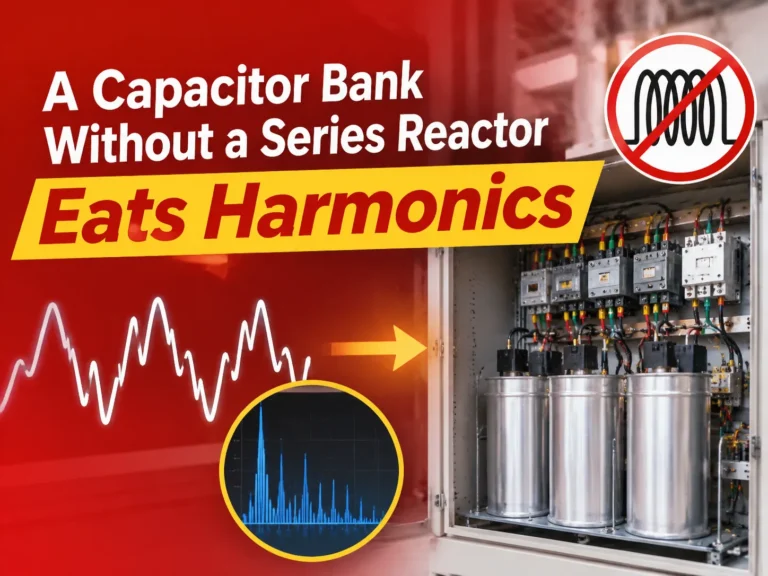
Worth remembering the mechanism: Xc = 1/(ωC), so capacitive impedance falls as frequency rises. Harmonic current concentrates in capacitors. A capacitor bank can also resonate with the supply inductance and amplify the harmonic it was supposed to tolerate.
Capacitor cabinet. Most exposed. Detuning is mandatory on any site with meaningful distortion: 7% reactors where the 5th and above dominate, 14% where the 3rd is significant. A bare bank on a harmonic-rich busbar is a component replacement programme with a delay built in.
SVC. Both a victim and a source. Phase-angle control produces characteristic 5th, 7th, 11th and 13th harmonics, so filter branches are part of the design, not an upgrade. Order them with the SVC; retrofitting filters into an existing installation is expensive and usually cramped.
SVG. Least affected, least generating. PWM at high switching frequency with a multilevel topology produces small high-order content that the coupling reactor filters. It can also run alongside an active power filter where the background distortion is severe. What it cannot do is replace that filter.
Maintenance: What You Actually Service
Capacitor cabinet. Capacitor ageing and bulging, discharge coils and reactors running hot, contactor contacts and fuses, inrush and switching overvoltage, thermal relay terminations, dust and ventilation. The work is find-and-replace, and there is a lot of it.
SVC. Thyristor valves and firing parameters, cooling fans and radiators, reactor noise and temperature, filter branch capacitors, and the thermal environment around the whole assembly. Cooling is the priority; a dusty plant with a blocked air path will lose the SVC before anything electrical fails.
SVG. Power module temperature and status, DC-link voltage and ripple, IGBT cooling, control and sampling circuits, cabinet heating. No contacts means no contact wear, so maintenance is monitoring and prevention rather than replacement.
The logic behind those differences: the cabinet is mechanical, so every operation is a wear event. The SVC is multi-branch coordination, so the branches have to stay matched. The SVG is a digital power electronic assembly, so what you watch is thermal.
One honest observation: the SVG is the more complex device on paper, but in daily operation it has fewer things that degrade. On comparable loads, long-term maintenance tends to be more predictable, not less.
Matching the Solution to the Site
Capacitor cabinet. Stable, slowly varying loads. Projects driven mainly by the power factor tariff. Buildings, commercial premises, conventional motor-driven production lines. If the goal is “avoid the reactive charge”, this is usually enough.
SVC. Large dynamic shock loads where response does not have to be instantaneous. Big motors, welding, electrolysis, rolling mills, mine hoists, substations. Mature technology, and economical at high capacity.
SVG. Fast impact loads and strict power quality requirements. Arc furnaces, spot welding, PV and wind farms, ports and cranes, rail traction, precision manufacturing. Also the answer where flicker, voltage sag or three-phase unbalance are part of the problem.
Three practical constraints filter the choice further: budget (cabinet is cheapest by a wide margin, SVC and SVG are comparable), floor space (cabinet smallest), and the skills available to operate and maintain the equipment.
A Selection Path in Seven Questions
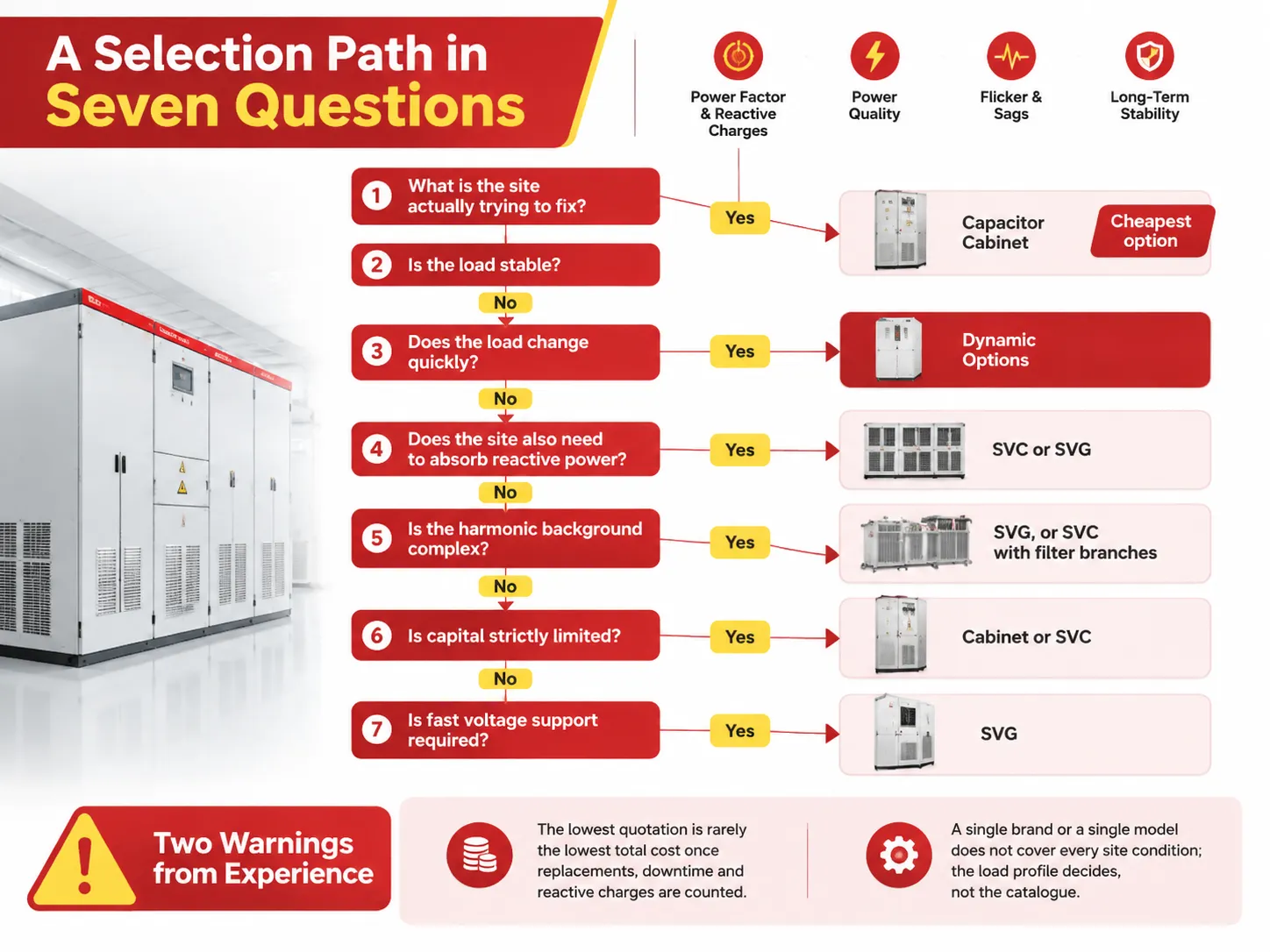
- What is the site actually trying to fix? Power factor and reactive charges, general power quality, flicker and sags, or long-run stability under a variable load.
- Is the load stable? If yes, a capacitor cabinet is often sufficient and always the cheapest.
- Does the load change quickly? If yes, move to the dynamic options.
- Does the site also need to absorb reactive power? If yes, SVC or SVG.
- Is the harmonic background complex? If yes, SVG, or SVC with filter branches.
- Is capital strictly limited? Cabinet or SVC.
- Is fast voltage support required? SVG.
Two warnings from experience. The lowest quotation is rarely the lowest total cost once replacements, downtime and reactive charges are counted. And a single brand or a single model does not cover every site condition; the load profile decides, not the catalogue.
Summary: Six Dimensions on One Page
| Dimension | Capacitor cabinet | SVC | SVG |
|---|---|---|---|
| Response | 100 ms to seconds | 10–20 ms | 1–10 ms |
| Resolution | Fixed steps, over/under-compensation | Near-continuous, TCR plus TSC | Continuous, kvar level, above 97% accuracy |
| Direction | Supply only | Both, asymmetric | Both, four-quadrant |
| Harmonics | Needs 7% or 14% detuning | Generates 5/7/11/13, needs filters | Minimal, can pair with APF |
In one line: the capacitor cabinet wins on economy, the SVC is traditional dynamic compensation at scale, and the SVG is high performance with fast two-way control. None of them is obsolete, and the site survey decides which one you are actually buying.
For the hardware side of each option, the KLD-SVG series covers active compensation, the thyristor switching range covers the SVC-style switched capacitor approach, and the intelligent capacitor range covers the modern cabinet.
FAQ
Is an SVG just a better capacitor cabinet?
No. A cabinet supplies fixed capacitive kvar in steps; an SVG generates reactive current continuously in either direction. They solve different problems and are frequently used together, with the cabinet carrying the base load.
Can an SVC reach the same accuracy as an SVG?
Close on steady loads, not on fast ones. The half-cycle firing granularity of the thyristor sets a floor on response that the SVC cannot go below, regardless of control tuning.
Why does the capacitor cabinet still dominate installed base?
Cost per kvar, and the fact that most sites have stable loads where step control is sufficient. It is a good solution used on the wrong sites that creates the bad reputation.
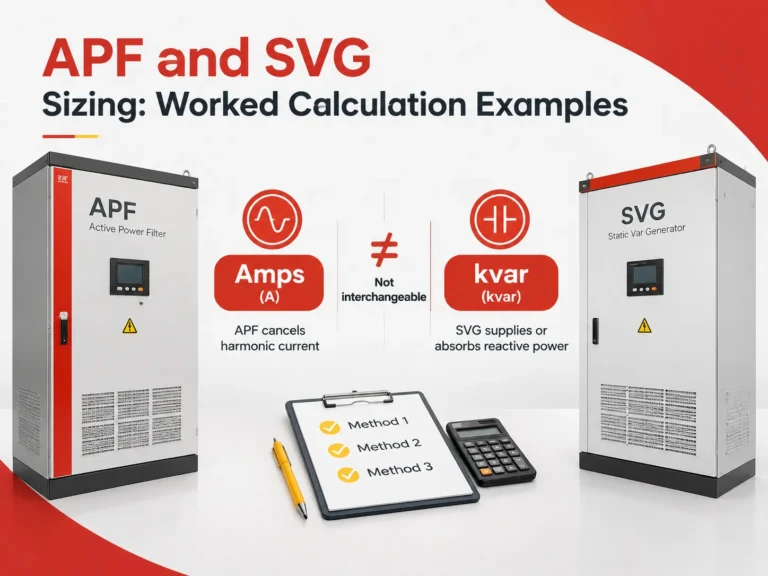
Do I need an APF as well as an SVG?
Only if harmonic distortion is a real problem. An SVG does not filter harmonics; it suppresses a small amount of low-order content. If THDu is over the limit, you need filtration.