

Most low-voltage distribution in a factory or a commercial building is described as three-phase four-wire, and most people who say it can draw it. Fewer can explain what the fourth wire is actually doing at three o’clock in the afternoon when the lighting circuit is at full load and only one production line is running.
That matters, because the neutral is where a surprising number of expensive failures happen.
What the Name Actually Describes
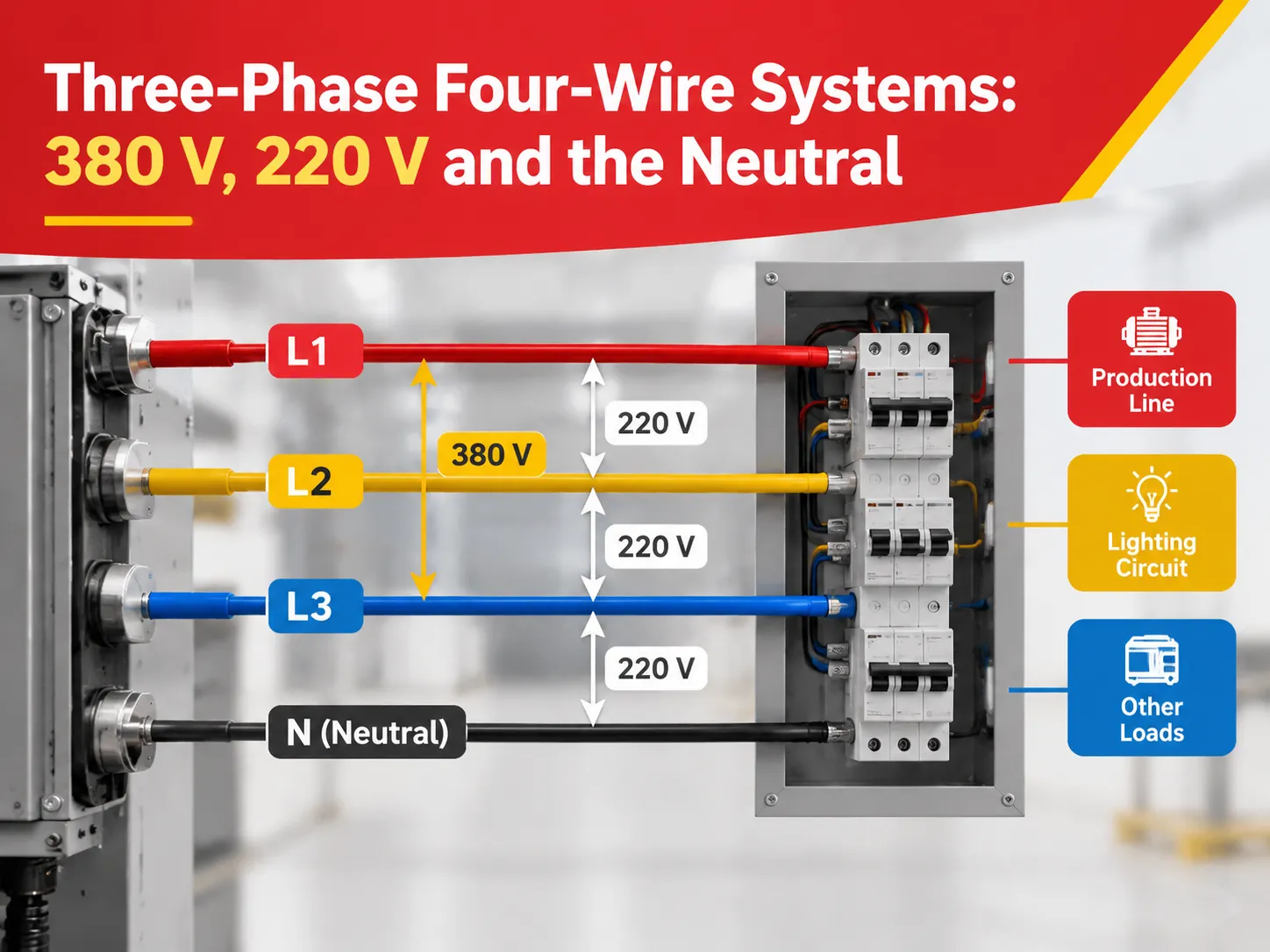
A three-phase four-wire system takes four conductors out of the transformer: three phase conductors and one neutral.
- A, B, C are the three phase conductors, the ones people call live.
- N is the neutral.
Between any two phase conductors you measure 380 V. That is the line voltage, or line-to-line voltage. Between any one phase conductor and the neutral you measure 220 V. That is the phase voltage.
The relationship between the two is not a coincidence and not a rounding: 220 × √3 ≈ 381. A three-phase supply gives you two usable voltage levels from one transformer, which is exactly why it became the standard arrangement for mixed industrial and commercial loads.
Where the Neutral Comes From
The neutral is the star point of the transformer secondary, brought out to a terminal. It exists because the three phase windings share a common return point, and single-phase loads need a return path that is at zero potential.
Take one more conductor from that neutral point, bond it to earth, and you have the protective earth conductor. Three phases plus neutral plus earth is the three-phase five-wire system, which is what modern installations actually use for socket outlets and exposed metalwork.
The distinction between N and PE is not decorative. N carries load current as a normal part of operation. PE should carry none, except under fault. Any current measured on PE is a fault indicator, not a design feature.
Colour Codes: Consistent and Not Consistent
In China the standard identification is yellow, green, red and light blue for A, B, C and N respectively. Phase conductor colours vary between countries, and anyone commissioning equipment from another market should check rather than assume.
Two things are effectively universal: the neutral is light blue, and the protective earth is green-and-yellow. Those two are the ones worth trusting when you open a panel you have never seen before, and the ones to verify first if a site has been modified by several contractors over the years.
What the Neutral Carries
With a perfectly balanced three-phase load of unity power factor, the three phase currents sum to zero and the neutral carries nothing. That is the textbook case, and it is almost never what a real site looks like.
Two things put current on the neutral:
Unbalance. Single-phase loads, office circuits, lighting, and one machine running while its neighbours are idle. The vector sum of the three phase currents is no longer zero, and the difference returns through the neutral.
Triplen harmonics. This is the one that catches people out. The 3rd, 9th and 15th harmonics are zero-sequence components: in all three phases they point the same direction at the same angle, so they cannot cancel each other. They add. On a site dominated by switch-mode power supplies, LED drivers and single-phase rectifiers, the neutral current can reach and exceed the phase current, and the neutral conductor is often the smallest one in the run.
The result is a neutral that runs hot, discolours at terminations, and eventually fails. When a neutral opens on a loaded four-wire system, the remaining single-phase loads see a line-to-line voltage divided unpredictably between them, and whatever is on the lightly loaded phase gets a surge it was not designed for.
Where the Neutral Becomes the Weak Point
Any site with a high proportion of electronic load. Offices with rows of computers. Retail with LED lighting on every circuit. Charging facilities. Modern machine tools with VFDs and switched-mode supplies inside them.
Older installations were designed when the neutral only had to carry unbalance, and it was routinely sized at half the phase conductor. That assumption is wrong for an electronic load mix, and the fix is either a larger neutral or removing the harmonic current before it reaches it.
Practical measures, roughly in order of cost:
- Rebalance single-phase loads across the three phases, and re-check the balance after any fit-out change.
- Upsize the neutral on new runs and on any feeder being replaced.
- Specify a four-wire active filter with neutral current compensation, which is the only measure that removes the third harmonic rather than tolerating it.
- Check terminations annually on any neutral carrying more than half its rated current.
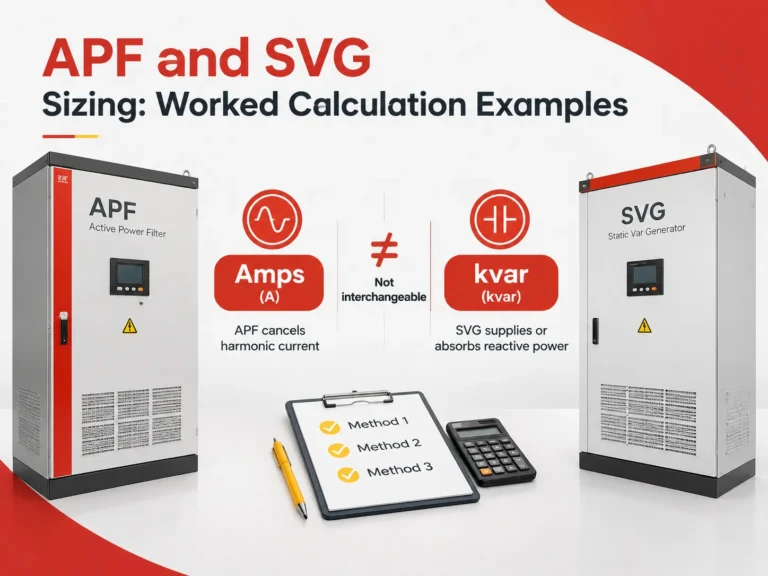
On the filtration side, the distinction between three-wire and four-wire hardware is not a detail. A standard three-wire active power filter has no neutral path at all, so it cannot help with the third harmonic problem described above. The four-wire variant, with a neutral CT and a neutral output, is the one specified for LED-heavy and office-heavy sites.
Checks Worth Doing on Any Four-Wire Board
Clamp the neutral and compare it with the phase currents. On a healthy, well-balanced site it should be a fraction of the phase current. On a site where it comes close to or exceeds a phase current, the harmonic content is the first thing to investigate, not the load balance.
Then check the terminations. Neutral failures are almost always termination failures first, because heat concentrates at a loose connection long before the conductor itself gives up.
Finally, confirm that the neutral is not switched or fused on a circuit that needs it continuous. It happens more often than it should, usually as a leftover from an older design philosophy.
FAQ
Is 380 V the same as 400 V?
In practice, yes. 380 V is the long-standing nominal figure in China; much of the world uses 400 V for the same class of system. The relationship to 220/230 V phase voltage is the same √3 ratio.
Can I run a three-phase load without a neutral?
Yes. A balanced three-phase motor or a three-wire drive does not need a neutral, because the return path is the other phases. The neutral only becomes necessary when single-phase loads are involved.
Why does my neutral read a higher current than any phase?
Triplen harmonics. The 3rd, 9th and 15th add in the neutral instead of cancelling, so a neutral current above the phase current is a strong indicator of a harmonic-rich electronic load mix.
Does a four-wire APF cost much more than a three-wire one?
More, but not dramatically, since the power stage is largely shared. The cost of not having it is a neutral conductor replacement plus downtime, which usually settles the argument.