

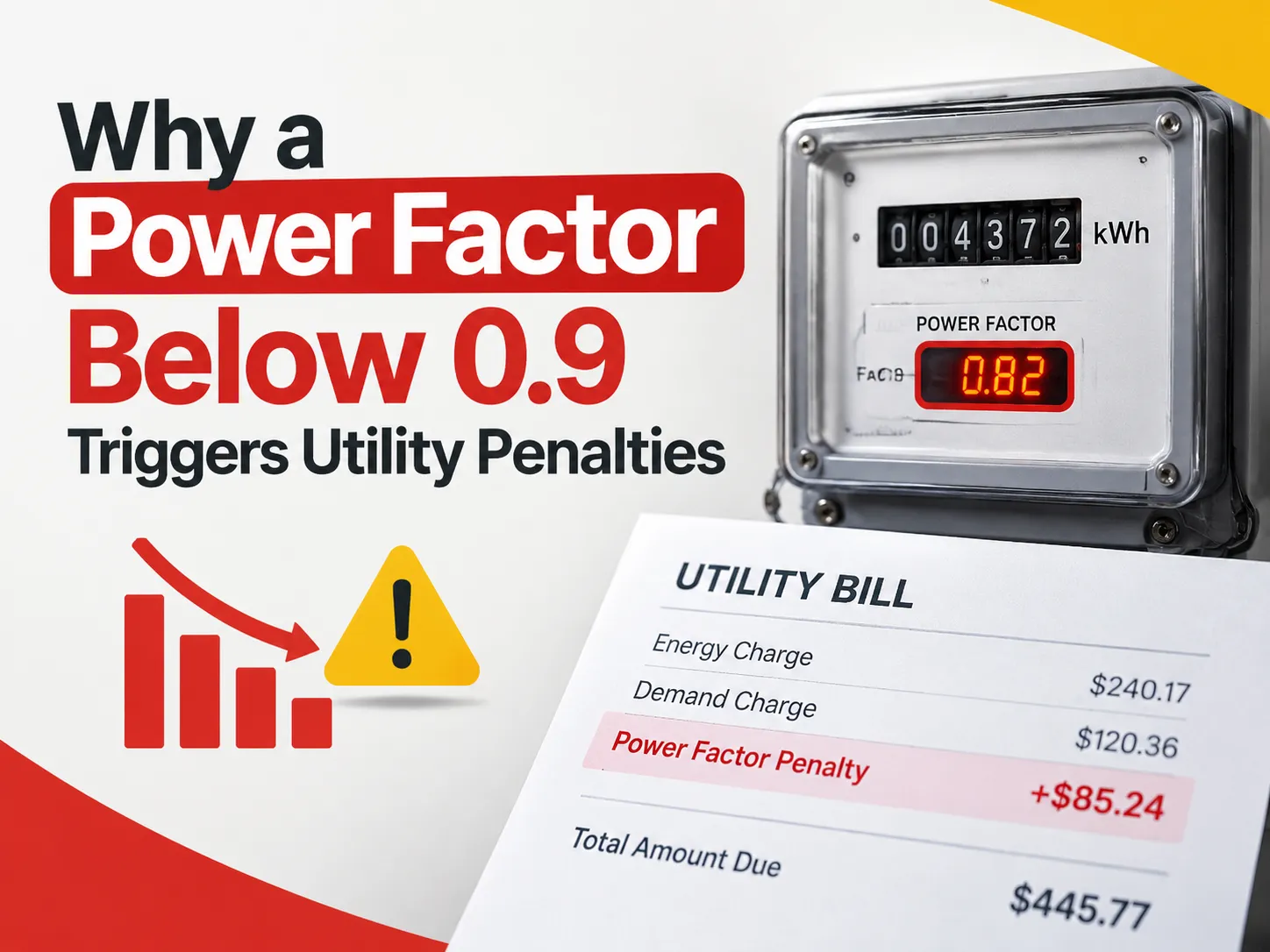
There is a line on most industrial electricity bills that nobody reads until the number gets large. It is usually labelled something like reactive power adjustment, power factor surcharge, or forced reactive charge, and it does not correspond to any energy the plant actually consumed.
It is a charge for capacity the plant reserved and did not use efficiently. Understanding why it exists makes it much easier to make it go away.
What Power Factor Measures
The utility delivers apparent power to your incoming terminals. Of that, the portion that produces real work, turning motors, heating furnaces, lighting the floor, is active power, measured in kW. Power factor is the ratio of the two.
A power factor of 1.0 means everything delivered was converted into useful work. A power factor of 0.7 means that for every 100 kVA the utility had to make available, only 70 kW did anything.
The missing 30 is not lost in the way heat is lost. It is reactive power, measured in kvar, and it shuttles back and forth between the supply and the magnetic fields inside motors and transformers. It is genuinely necessary for those machines to run. It just doesn’t turn a shaft or melt anything.
Why Utilities Charge for It
Because it consumes capacity. A transformer rated 1000 kVA delivering power at 0.7 power factor is supplying 700 kW and is fully loaded. The same transformer at 0.95 delivers 950 kW. The utility built the cables, the transformer and the switchgear for the full 1000 kVA either way, and at low power factor it carries the losses of that full current while billing for less useful energy.
So the surcharge is not a penalty in the punitive sense. It is a charge for infrastructure the customer is occupying without paying for. Most tariff structures apply it below a threshold of 0.9, and stop applying it once the site is at or above that figure, because at 0.9 the reactive component is small enough to be considered a normal cost of supply.
The buffet comparison works better than most analogies of this kind. The restaurant charges a fixed price for all you can eat, but if you pile up plates and leave most of the food, some of them add a waste charge. Nobody is stopping you from taking the food. They are charging for the part you didn’t use.
Where Low Power Factor Comes From
Almost always from induction motors and transformers running at part load.
A motor draws reactive power to establish its magnetic field, and that magnetising current barely changes with load. Run a 75 kW motor at 75 kW and its power factor might be 0.88. Run the same motor at 15 kW and it drops to 0.6, because the magnetising current is unchanged while the useful current has fallen away. Every oversized, lightly loaded motor on site makes the plant’s power factor worse.
Two common patterns follow from this. Plants that run the same equipment day and night usually have a reasonable power factor. Plants with a heavy daytime load and a lightly loaded night shift often fail the tariff threshold overnight, when the only things drawing power are transformers, cooling fans and lighting.
How Capacitors Fix It
A capacitor and an inductor exchange energy in opposite phase. When an inductive load is absorbing reactive power to build its field, a capacitor is releasing it; when the field collapses, the capacitor absorbs. Put them on the same busbar and the exchange happens locally instead of travelling back to the substation.
That is the entire working principle of a capacitor compensation cabinet, and it is why the equipment is cheap for what it does. The reactive power is still needed and still flows, but it now flows between the capacitor and the motor rather than between the plant and the utility.
What you get for it:
- The power factor surcharge disappears once the site is back above 0.9.
- Current in the incoming cables drops, so I²R losses drop with it.
- Transformer capacity is freed up for actual production load.
- Voltage at the far end of long feeders improves, sometimes noticeably.
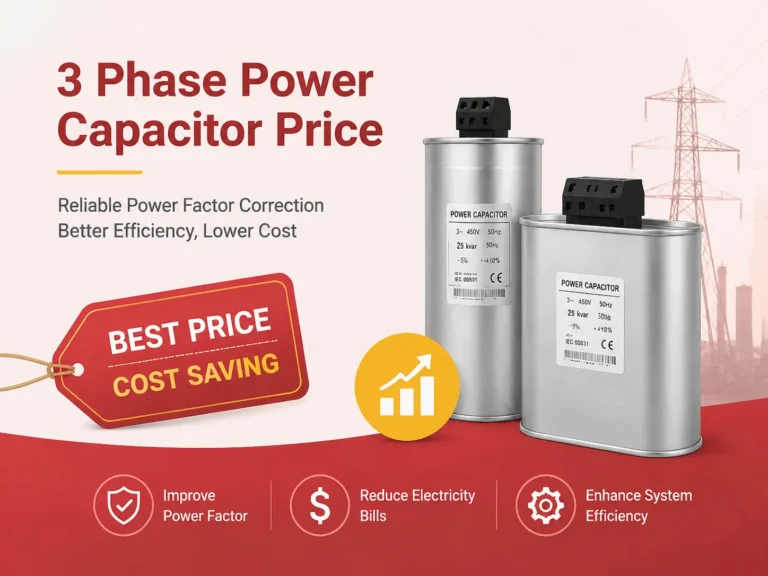
Capacitor banks need to be designed, not simply bought. Steps have to match the load profile, and reactors have to be selected against the site’s harmonic background, because a capacitor bank on a harmonic-rich busbar is a resonance waiting to happen. The low-voltage power capacitors used in these banks are usually paired with detuning reactors for exactly that reason.
When Capacitors Aren’t Enough
A capacitor cabinet corrects the average. It does not correct the moment. If the plant has impact loads, welding, press lines, crane duty, or a power factor that swings every few minutes, the contactors will be switching constantly, the steps will overshoot and undershoot, and the equipment wears out from hunting.
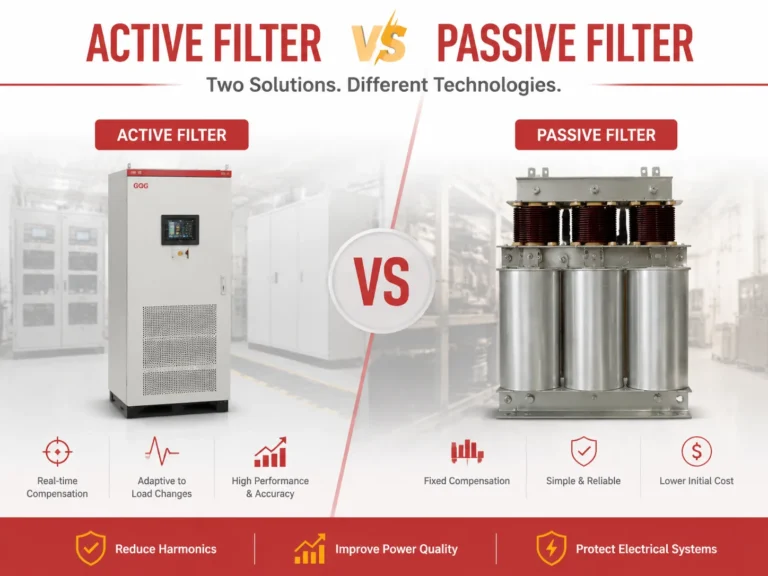
That is the point where an active compensation device becomes the cheaper answer over five years, even though it costs more on day one. It follows the load instead of stepping after it.
A Quick Check on Your Own Bill
Take active energy and reactive energy for the same month. Divide active by the square root of (active² + reactive²). If the result is 0.85, a capacitor bank sized to the average load will usually get you above 0.95 and pay for itself in two to three years at typical tariff levels. If the result is 0.85 but the monthly figures fluctuate wildly, look at the load profile before choosing hardware.
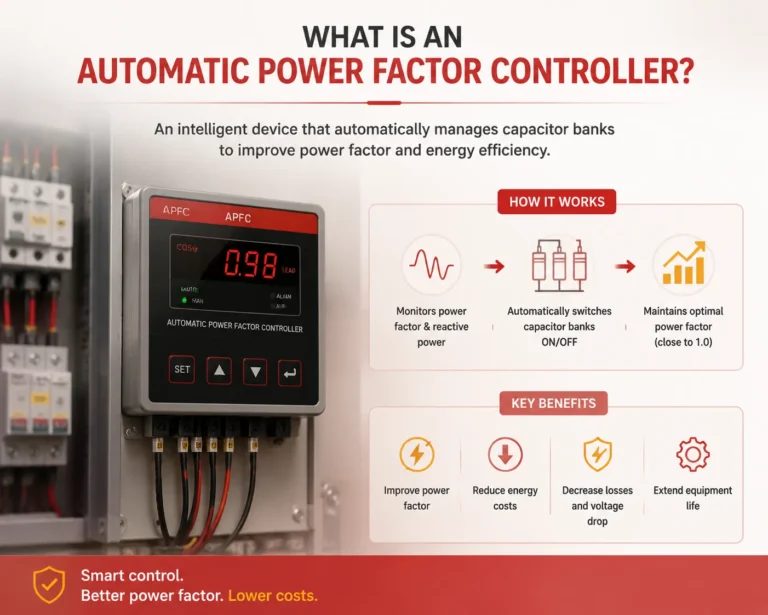
One more thing worth checking: whether the existing compensation is actually working. Controllers fail, capacitors age, fuses blow, and a cabinet that has been in service for eight years may be doing very little while everyone assumes it is fine.
FAQ
Is 0.9 the universal threshold?
No. 0.9 is the most common figure in Chinese industrial tariffs and appears widely elsewhere, but the exact threshold and the surcharge formula vary by utility and by contract. Read your own tariff document.
Can I be penalised for a power factor that is too high?
In some tariffs, yes. Leading power factor from over-compensation pushes reactive power back onto the grid, which causes its own voltage problems. This is why step control and, on fluctuating sites, active compensation matter.
Does improving power factor reduce kWh consumption?
Not directly, since the metered active energy is unchanged. It reduces losses in cables and transformers, so the kWh drawn from the utility does fall slightly. The larger saving is the surcharge and the released capacity.
Will capacitors fix a harmonic problem too?
No, and on a harmonic-rich site an un-detuned capacitor bank will make things worse by resonating with the supply inductance. Harmonics need a filter, either passive with a detuned reactor or active.