

A plant loses a shift of production and nobody can say why. The drives tripped, the PLC dropped out, the line stopped, and by the time the electrician reached the MCC everything was back to normal and the meters showed nothing wrong.
That is the signature of a voltage transient, and it is one of the harder things to investigate after the fact, because the event lasts tens of milliseconds and leaves almost no trace unless something was recording.
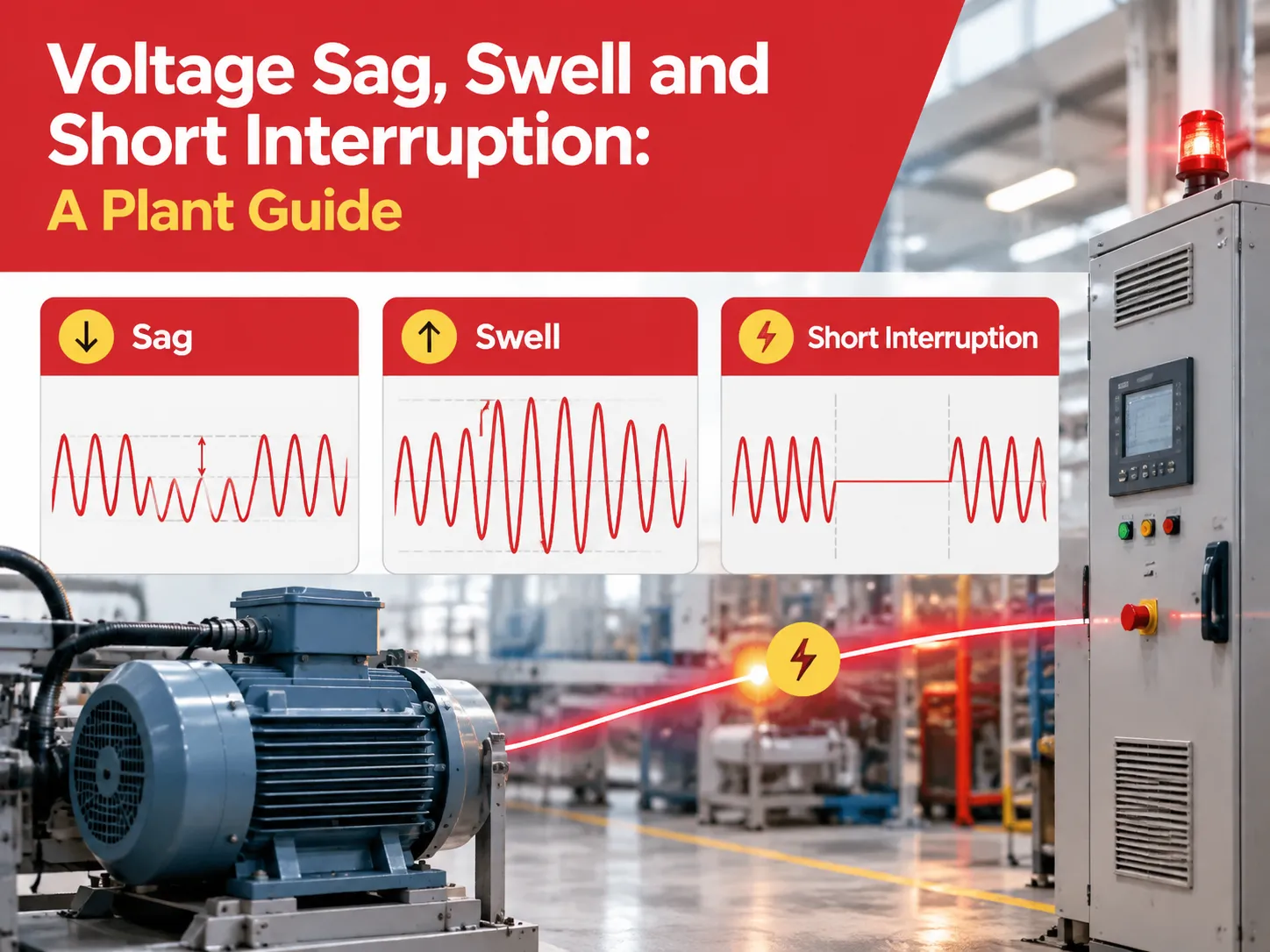
Three events account for most of these incidents: voltage sag, voltage swell and short interruption. They look similar on a waveform, they have completely different causes, and they need different mitigation. Getting the name right is the first step to fixing the problem.
Start With the Standards, Not With a Rule of Thumb
Site arguments about whether an event “counts” are usually settled by looking at a definition. In China the relevant documents are:
- GB/T 12325-2008 — supply voltage deviation. Steady-state only, ±7% for three-phase systems at 20 kV and below, +7%/−10% for 220 V single-phase. It does not cover millisecond events, and applying it to a transient is a common error.
- GB/T 15945-2008 — frequency deviation. Also steady-state.
- GB/T 30137-2013 — voltage sag and short interruption. This is the one to cite for terms, amplitude bands, duration, classification and measurement method.
- GB/T 18481-2001 — temporary and transient overvoltage. Lightning and switching surges, a different family of events from a fault-induced swell.
- GB/T 19862-2005 — general requirements for power quality monitoring equipment. Relevant when you specify the recorder itself.
Voltage Sag
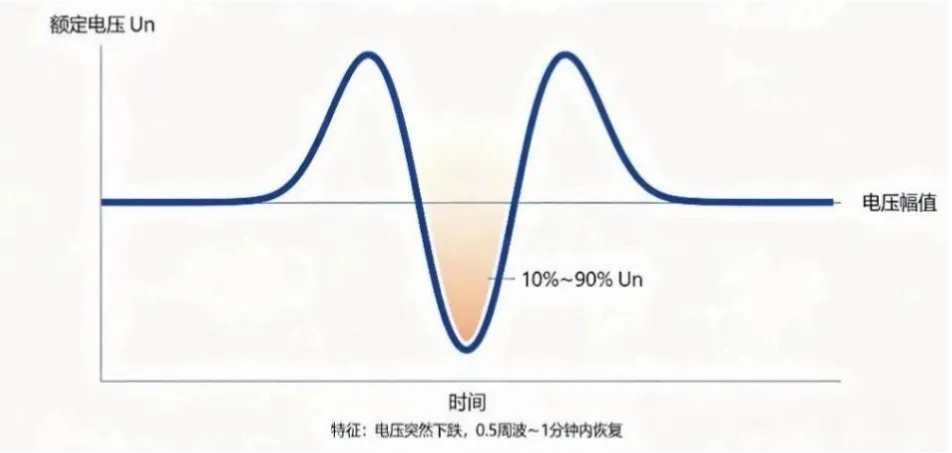
A sag is a sudden drop of the RMS supply voltage to somewhere between 90% and 10% of nominal, recovering to normal within half a cycle to one minute.
- Amplitude: residual voltage between 10% and 90% of nominal.
- Duration: half a power-frequency cycle (10 ms at 50 Hz) up to one minute.
- Signature: a fast drop followed by a self-recovery.
Short circuits on the network are the dominant cause. The voltage collapses the instant the fault occurs and recovers as soon as protection clears it. The whole sequence may last 60 to 300 ms, which feels like nothing until you remember that a VFD can trip on an undervoltage condition after 10 ms.
Voltage Swell
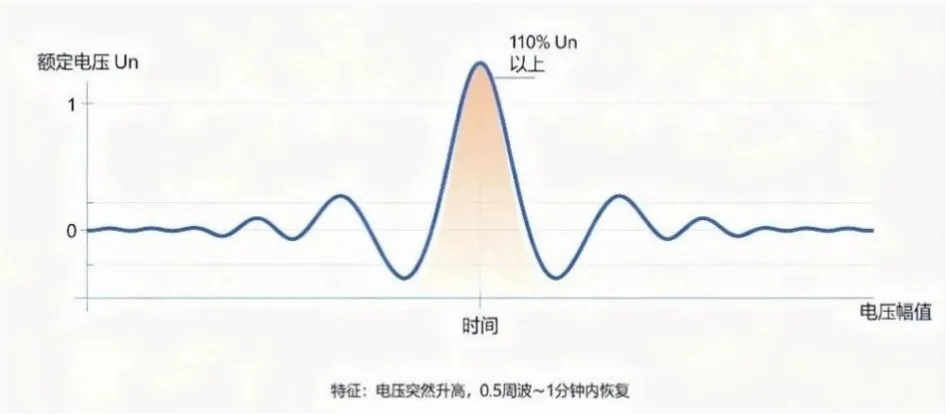
A swell is the mirror image: RMS voltage rising above 110% of nominal, recovering within half a cycle to one minute.
- Amplitude: above 110% of nominal, with 110%–180% used in classification.
- Duration: half a cycle to one minute.
- Signature: a sharp upward excursion followed by a decay back to normal.
Common causes are the sudden loss of a large load, a single-phase earth fault on an otherwise healthy system, and the switching of capacitor banks. Swells are less frequent than sags, typically a fraction of them, but the damage per event is worse: insulation stress and electronic component failure rather than a clean trip.
Short Interruption
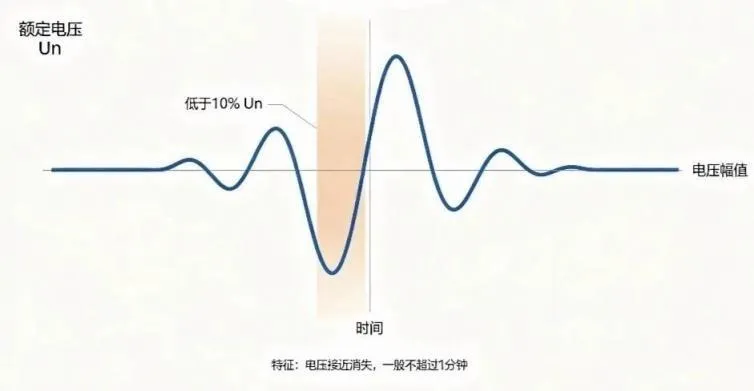
A short interruption is the supply disappearing entirely for a period that generally does not exceed one minute, judged by the voltage falling below 10% of nominal.
- Amplitude: below 10% of nominal, effectively a loss of supply.
- Duration: usually within 3 s in practice, with a one-minute upper limit.
- Signature: voltage all but disappears, then returns.
The practical difference from a sag is that a sag still leaves a usable residual voltage, while a short interruption does not. Automatic transfer to a standby source, recloser operation and upstream line faults all produce them. For most plant equipment, a short interruption behaves like an outage: everything stops.
Side by Side
| Dimension | Voltage sag | Voltage swell | Short interruption |
|---|---|---|---|
| Definition | Drops to 10%–90% of Un | Rises to 110%–180% of Un | Below 10% of Un |
| Duration | 10 ms to 1 min | 10 ms to 1 min | 10 ms to 1 min, mostly under 3 s |
| Typical amplitude | Residual 20%–80% of Un | Peak 120%–150% of Un | Residual below 10% of Un |
| Frequency | Highest; tens to hundreds per year at industrial sites | Roughly 1/7 to 1/10 of sag events | Roughly 1/10 of sag events |
| Main causes | Short-circuit faults, direct starting of large motors | Load rejection, single-phase earth fault, capacitor switching | Standby transfer, line reclosing, breaker tripping |
| Equipment effect | VFDs and PLCs trip, process data lost | Insulation breakdown, DC capacitor failure | Most equipment stops outright |
| Mitigation | UPS, DVR, solid-state transfer switch | Overvoltage protection, active voltage regulation, SPD | UPS, EPS, dual-supply transfer |
| Severity | Frequent; downtime accumulates | Rare; each event damages hardware | Rare; impact is immediate and total |
The frequency figures come from long-term monitoring in industrial parks rather than from mandatory standard values, and they vary widely by region and by how the customer’s distribution is configured. Treat them as an order of magnitude, not a specification.
What It Does to Equipment
- VFDs. Extremely sensitive. A drop below 70% of nominal lasting more than 10 ms is often enough to trigger an undervoltage trip.
- PLC and DCS. In control circuits without UPS support, a sag or a short interruption stops the controller directly.
- AC contactors. Release voltage sits at 40%–60% of coil rating, so a deep sag drops the contactor and stops the motor even though nothing is wrong with the motor.
- Computers and servers. A dip causes a shutdown; the shutdown causes the data loss, which is usually the expensive part.
- Precision instruments. Swells break down components; sags corrupt readings and invalidate test data.
- Motors. A brief sag does not damage the motor. Speed dips, then recovers on its own. The loss is the process interruption, not the machine.
What It Costs Different Industries
A semiconductor plant can scrap an entire line’s material on one deep sag, which is why the industry measures these events obsessively. An automotive plant loses a whole line when robots stop and need re-homing. Petrochemical plants face process upsets that can escalate into safety incidents. Textile plants scrap the fabric on the loom. Data centres lose transactions.
The pattern across all of them: the loss is not the energy, it is the restart. Which is why mitigation is usually justified on restart cost rather than on power cost.
Device-Level Mitigation
Appropriate when a handful of machines are affected and the rest of the plant rides through.
- Delay-release contactors. The coil holds in through a brief dip instead of dropping out, which covers the majority of shallow sags for motor circuits.
- VFD parameter tuning. Enable undervoltage restart and flying restart so the drive picks up a spinning motor when voltage returns, rather than tripping and waiting for a manual reset.
- Regulated supply or UPS on the control circuit. Cheap insurance for the PLC, since the controller is often the single point that stops everything.
The limitation is scale. Once dozens of devices are affected, the retrofit labour exceeds the value of the fix.
System-Level Mitigation
- UPS. Holds the load through sags and short interruptions. Expensive, battery maintenance is real, and it is normally applied to control systems, equipment rooms and data halls rather than whole plants.
- DVR (dynamic voltage restorer). Purpose-built for sags and flicker. Fast, and usually the best cost-performance for a feeder-level fix. It compensates for seconds, not hours, so it is not an outage solution.
- SSTS (solid-state transfer switch). Where two independent supplies exist, transfers in milliseconds. Useless if both supplies come from the same busbar.
- Flywheel storage. No batteries, long life, fast response, high capital cost. Fits second-scale ride-through.
- Active voltage regulation and reactive compensation. Addresses the voltage instability side, particularly where the sag is caused by the plant’s own load steps. Severe harmonics call for filtration alongside it.
Worked Example: Will This Contactor Hold?
A plant has an AC contactor with a 220 V coil and a release threshold of 0.5 × Un, or 110 V. The supply takes a sag with a residual per-unit voltage of 0.4.
Step 1. Coil voltage during the sag: Ures = 220 × 0.4 = 88 V.
Step 2. Compare with the release threshold: 88 V is below 110 V.
So the contactor drops out and the motor stops, even though the supply recovered in under 200 ms and nothing was damaged.
Now invert the question: how deep a sag can this contactor survive? It holds as long as Ures ≥ 110 V, which means the residual per-unit voltage must stay above 0.5. Anything deeper drops it out.
That single number explains why ordinary contactors have such poor ride-through, and why delay-release versions exist. Note also that release voltage varies between 0.3 and 0.6 of nominal depending on the device, so the threshold should be read from the datasheet rather than assumed.
FAQ
What is the difference between a sag and a short interruption?
The residual voltage. A sag leaves between 10% and 90% of nominal; a short interruption leaves less than 10%. The consequence is that most equipment keeps running through a shallow sag and stops during an interruption.
Can a voltage sag be prevented?
Rarely, because most are caused by faults elsewhere on the network. What can be done is ride-through: making the plant’s own equipment tolerate the event instead of tripping.
How do I know which events my plant actually has?
Install a power quality monitor at the incoming panel that records transients, not just averages. Monthly averaged data will never show a 100 ms event.
Is a UPS always the answer?
No. For sags and flicker a DVR is often cheaper and better matched. A UPS is the right answer when the requirement extends to outages, or when the load is small enough that battery cost is trivial.