

Ask a plant electrician why the capacitor cabinet keeps tripping and you will usually hear one of two answers: the capacitors are worn out, or the controller is faulty. Occasionally both are true. More often the cabinet is being asked to do something it was never built for, on a load that changes faster than grouped contactors can follow.
That is the situation an SVG exists for. Not because capacitors are bad, but because a capacitor bank and a static var generator solve reactive power in fundamentally different ways.
What an SVG Is, and What It Is Not
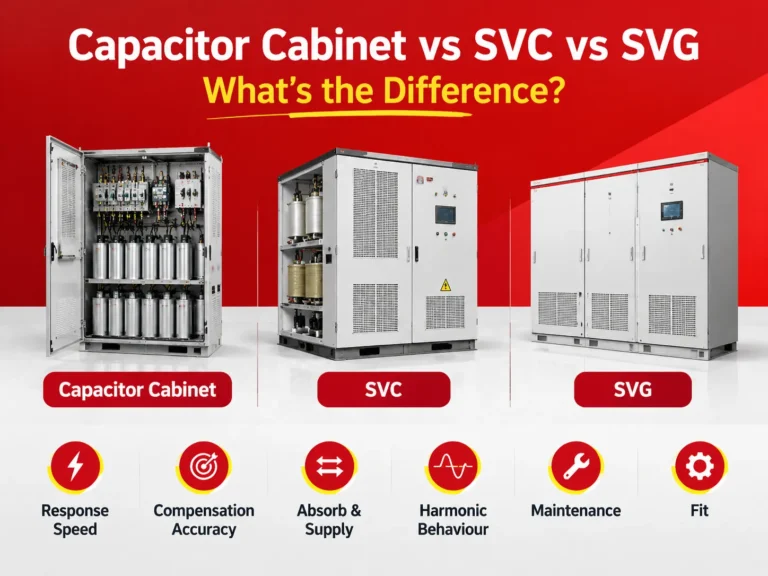
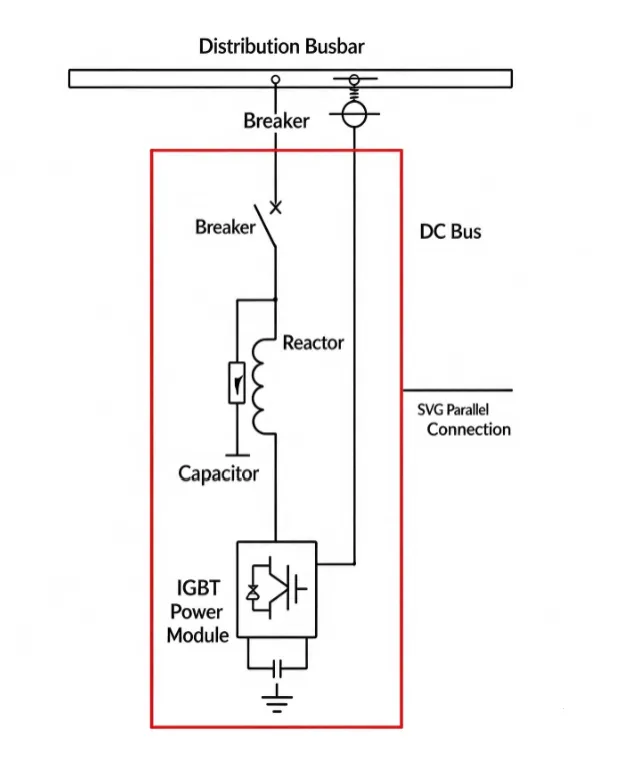
A static var generator is often described as an upgraded capacitor cabinet. It is not. A capacitor cabinet is a passive bank of capacitance that gets switched in and out. An SVG is an active device, connected in parallel to the distribution busbar, that generates reactive power in real time instead of storing it.
The hardware is closer to a variable speed drive than to a capacitor panel: IGBT power modules, output reactors and a DC bus system, all under digital control.
That parallel connection matters. The SVG does not sit in series with the load, so it does not carry load current and a failure inside it does not interrupt production. It watches the busbar and injects current into it.
How It Regulates, Step by Step
The control loop is conceptually simple, even if the execution is not. The controller samples grid voltage and current continuously. The moment it detects a reactive power demand, it calculates the current required and the inverter produces it.
- Inductive load dominating: the SVG outputs capacitive reactive power, which is what lifts the power factor back toward unity.
- Surplus capacitive reactive power on the system: the SVG absorbs the excess instead of adding to it, which is what stops the busbar voltage from climbing.
That second direction is where a capacitor bank simply cannot compete. A capacitor can only supply. An SVG can supply or absorb, and it crosses zero without a jump.
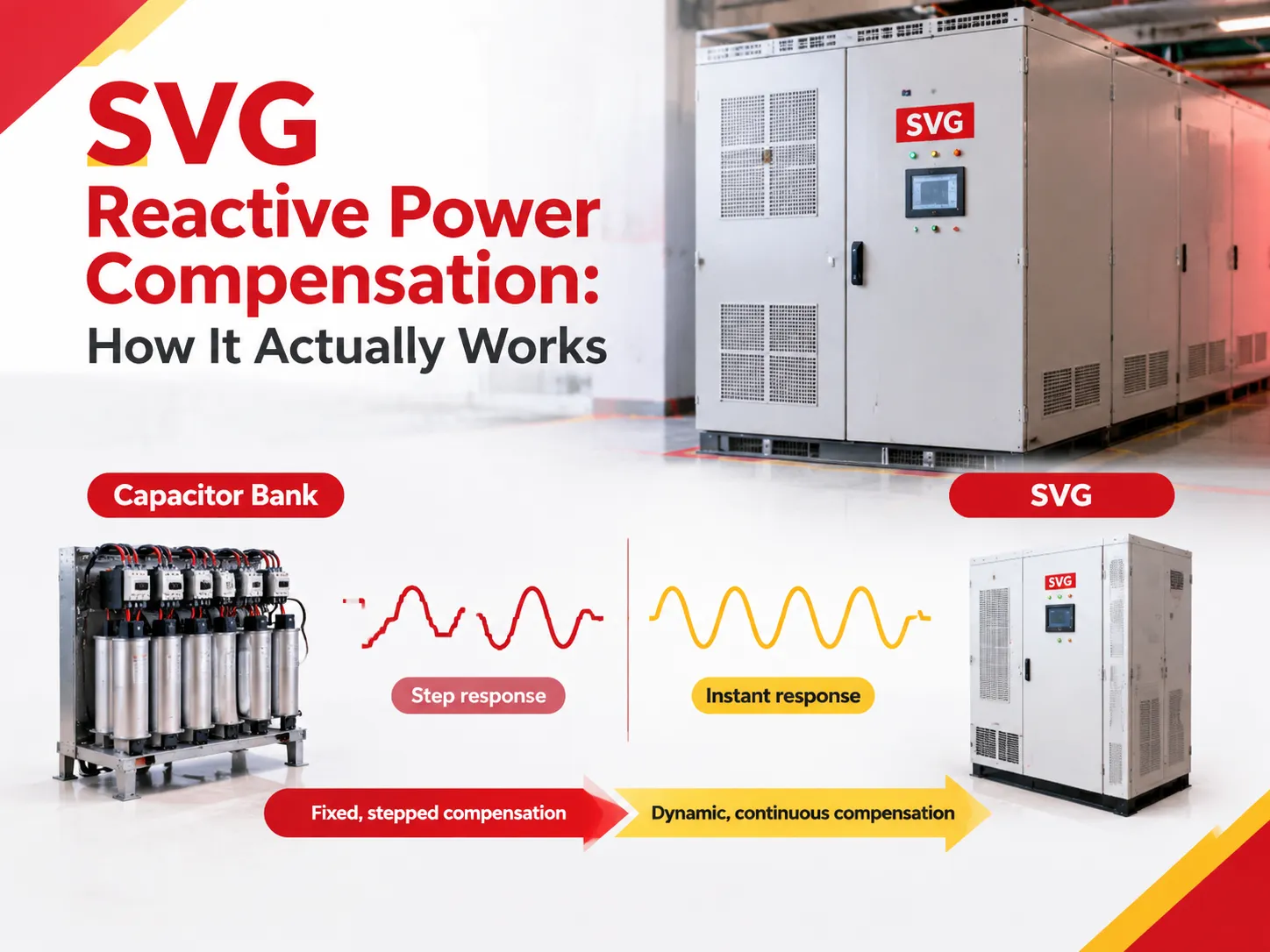
The regulation is continuous rather than stepped. There is no contactor picking up, no group of capacitors dropping in and out, and therefore no step change in busbar voltage that the rest of the plant has to absorb. Response lands in the millisecond range, which is fast enough to track welding machines cycling on and off, VFD banks loading and unloading, and a power factor that moves all afternoon.
Capacitor Bank vs SVG: Two Different Control Philosophies
The cleanest way to describe the difference is timing. Capacitor compensation is passive and after the fact: the load changes, the controller notices, a contactor closes, and the correction arrives a moment later in whatever step size the bank happens to have. SVG is real-time control: the correction arrives with the disturbance.
For a steady load, this distinction costs you money and buys nothing. A plant running the same motors all day will do fine with a well-designed capacitor cabinet and a detuned reactor. Where it changes is on load profiles with impact. Electric welding, press lines, crushers, rolling mill drives, and any site where the power factor oscillates rather than drifts.
The rule of thumb is blunt: the greater the load impact and the faster the fluctuation, the more an SVG is worth. On a site with heavy shock loads and a power factor that swings every shift, a capacitor cabinet alone rarely solves the problem, and adding more capacitor steps often makes it worse by hunting.
Where an SVG Earns Its Price
- Welding lines. Dozens of welding machines firing in sequence produce reactive demand that looks like noise. An SVG tracks it; a stepped bank chases it.
- Steel and rolling mills. Impact loads produce rapid reactive changes that a fixed-step bank cannot resolve, and the resulting voltage flicker shows up in product quality.
- VFD-heavy systems. Drives improve displacement power factor internally but the site-level reactive profile still moves with load, so compensation has to move with it.
- Large industrial halls. When a dozen machines start and stop independently, the aggregate reactive demand never settles. Continuous compensation handles the aggregate.
There is also a voltage argument. Because an SVG behaves as a current source rather than an impedance, its output does not collapse when the busbar voltage sags. A capacitor bank’s output falls with the square of voltage, exactly when you need it most.
When an SVG Is the Wrong Answer
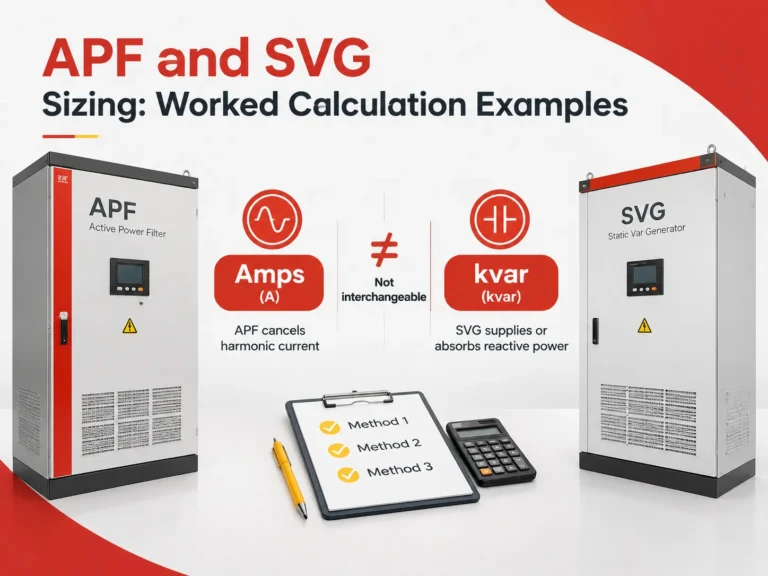
An SVG compensates reactive power. It is not a harmonic filter, and buying one to fix a distortion problem is an expensive way to be disappointed.
If the site has significant harmonic distortion alongside the reactive problem, evaluate an active power filter as well, or a combined scheme. An SVG can suppress a little low-order harmonic content as a side effect, but it cannot bring a 12% THDu busbar back inside the 5% limit.
In practice the two devices complement each other: the SVG holds voltage and power factor, the APF cleans the waveform, and capacitors carry the steady base load because they cost a fraction of what active compensation costs per kvar.
What to Check Before Specifying
Capacity, not maximum capacity. More kvar is not automatically better. The usual approach is to let capacitors cover the base and use the SVG for the dynamic remainder. On a 2500 kVA transformer, 800 kvar of capacitors plus a 200 kvar SVG is a sound split; sizing the full 1000 kvar as SVG is not.
Response time in the specification, not the brochure. Ask for the closed-loop response, not just the sampling rate. “Millisecond” appears in every datasheet; the number that matters is how long the output takes to reach the commanded current.
Harmonic background. A high background distortion changes what the SVG must tolerate and how it should be rated. Measure before you specify.
Cooling and location. An SVG generates heat in a concentrated place. Cabinet ventilation, ambient temperature and dust all affect service life more than the control algorithm does.
For a look at how these devices are built and specified in practice, the KLD-SVG series covers wall-mounted and cabinet formats for low-voltage distribution. If you are still deciding between compensation technologies, the comparison of active and passive filters is a useful companion read for the harmonic side of the same decision.
FAQ
Does an SVG replace the capacitor cabinet entirely?
Usually not, and it shouldn’t. Capacitors are the cheapest kvar you can buy for a steady base load. The economic design uses capacitors for the base and an SVG for the variable part.
How fast does an SVG actually respond?
Commercially available units respond in the low millisecond range, with control loops running far faster. That is enough to track welding and impact loads; it is not instantaneous, and no device is.
Will an SVG reduce my electricity bill?
It removes reactive power charges and reduces losses in cables and transformers. How much that comes to depends on your tariff structure and how far below the threshold your power factor currently sits.
Can an SVG cause harmonics of its own?
It switches at high frequency, so it produces some high-order content near the switching frequency, which the output reactor largely filters. This is a very different situation from the characteristic 5th and 7th harmonics produced by thyristor-controlled SVC equipment.