

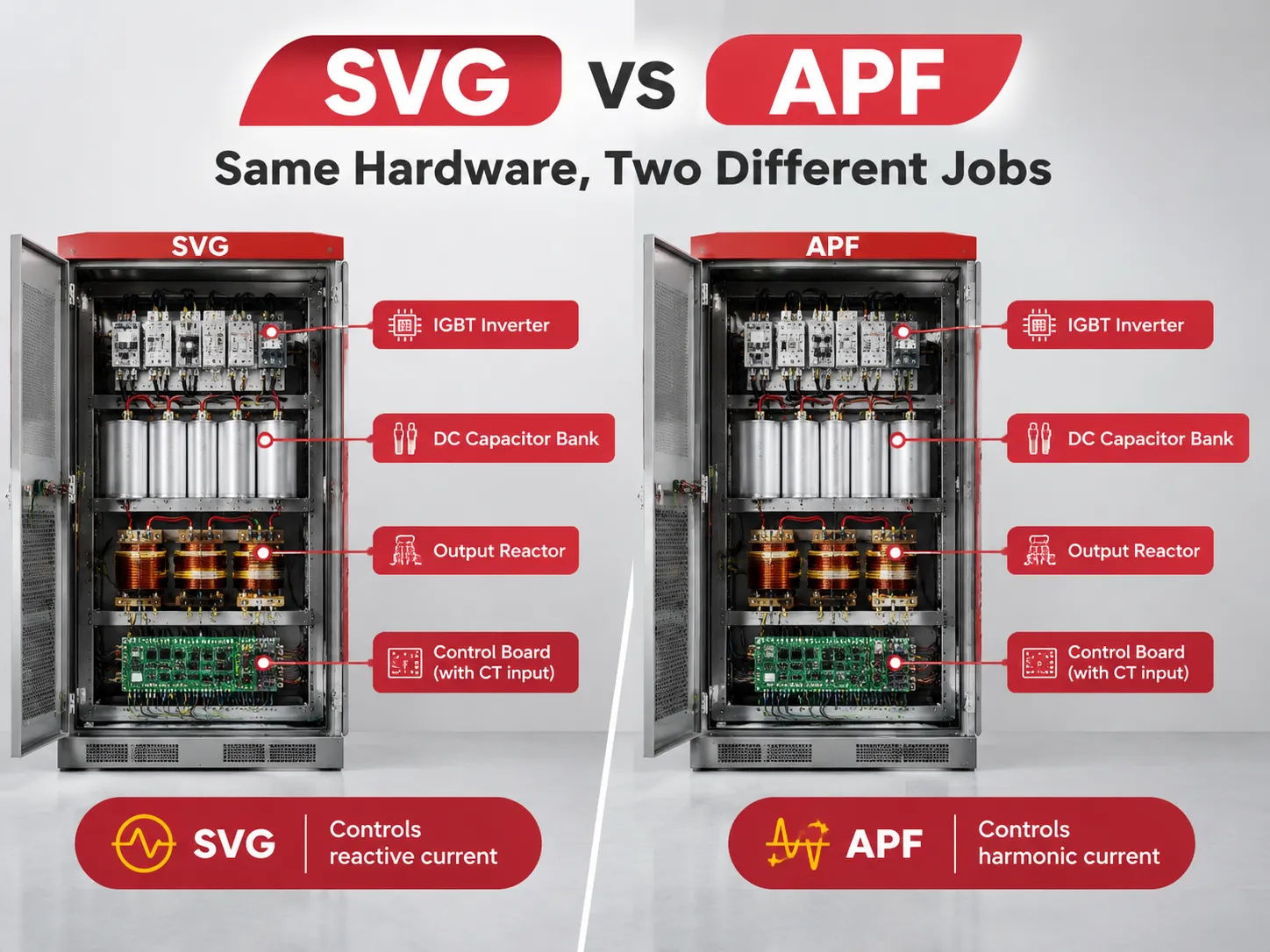
Open the doors on a static var generator and an active power filter and you will see almost the same thing: an IGBT three-phase inverter, a large DC capacitor bank, an output reactor, and a control board with a CT input. Both connect in parallel on the 0.4 kV busbar. A technician who has only seen the outside would struggle to tell them apart.
The difference is in the firmware, and it produces two devices that cannot substitute for each other. One controls reactive current. The other controls harmonic current. Choosing the wrong one is one of the more common and more expensive mistakes in low-voltage power quality work.
What an SVG Controls
An SVG (static var generator, sometimes written ASVG) regulates two things: power factor and busbar voltage. Its internal inverter turns the DC-link voltage into an AC voltage that matches the grid in frequency and phase, and by controlling the small difference between its output voltage and the grid voltage it exchanges reactive power with the system in either direction.
- Output voltage slightly above grid voltage: capacitive reactive power flows out, which compensates inductive loads and lifts the voltage.
- Output voltage slightly below grid voltage: the device absorbs inductive reactive power, which pulls an overvoltage down.
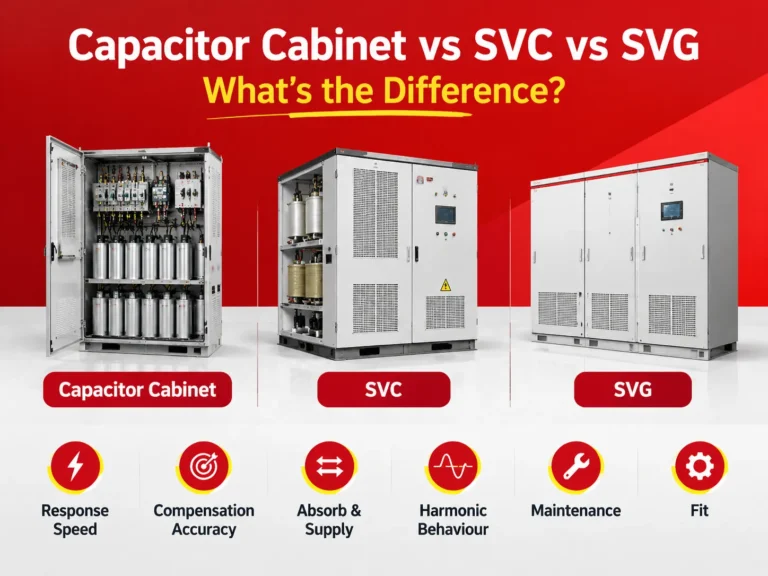
Because the output is continuously adjustable, there is no step change and no switching transient. This is what a capacitor cabinet cannot do, and it is why SVG is the answer for stepwise compensation, over-compensation, under-compensation and voltage that will not hold steady.
Inside the control loop
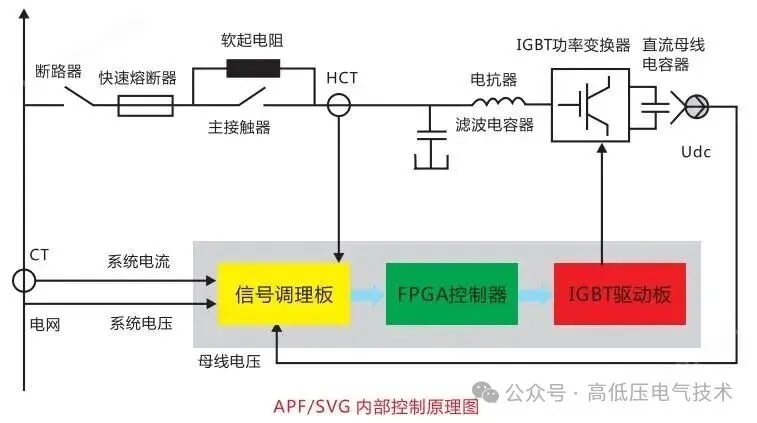
Both devices share the same signal path, which is why the cabinets look identical. Current and voltage transformers feed a conditioning board, an FPGA or DSP controller runs the algorithm, an IGBT driver board fires the power stage, and the output reactor couples the result to the busbar. Same road, different destination.
Around the power stage you find the usual protection chain: circuit breaker, fast fuse, soft-start resistor, main contactor, output reactor, filter capacitor and DC bus capacitor. The topology is deliberately shared, because building one proven power platform and writing two control strategies is cheaper than building two platforms.
What an APF Controls
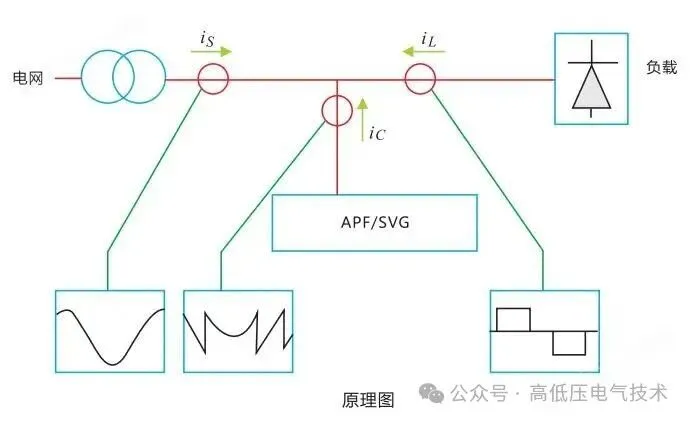
An APF (active power filter, also called an active harmonic filter) does one job: it removes harmonic current from the system. A high-accuracy CT samples the distorted load current, a DSP separates the 2nd to 50th order harmonic content along with the reactive and unbalanced components, and the inverter injects a current of equal amplitude and opposite phase. The harmonics cancel. What remains on the grid side is close to a clean sine wave.
The measurement point matters here. An APF compensates what it can see, so a CT upstream of the whole plant cleans the incoming supply, while a CT on a single drive’s feeder cleans only that feeder. Most site problems are best solved at the point where the loads that cause them are collected.
Five Differences That Actually Decide the Choice
Control target. The SVG targets grid voltage and power factor. The APF targets cancellation of load harmonics. Everything else follows from this.
What is being compensated. The SVG works on 50 Hz fundamental reactive current. The APF works on 2nd to 50th order harmonic current. They operate in different frequency domains; that is why one cannot replace the other.
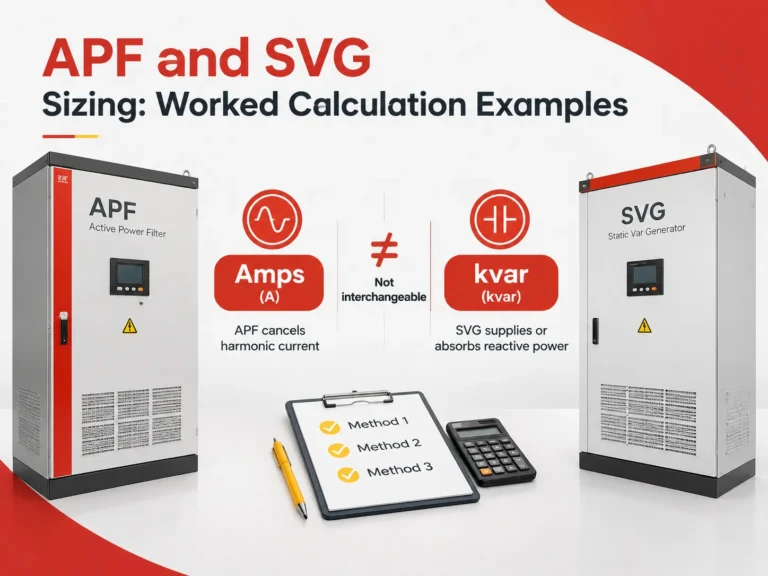
Capacity unit. SVG is rated in kvar, APF in amps. A 100 kvar SVG and a 100 A APF are not comparable quantities, and quotations that mix the units are worth a second look.
Control logic. The SVG closes a voltage and power factor loop. The APF closes a current-cancellation loop on the load current. Different feedback signals, different dynamics.
Capability boundaries. An SVG can suppress a small amount of low-order harmonic content but cannot fix high-order distortion or bring THDu back inside the limit. An APF can offset some reactive power but its reactive capacity is small next to a real deficit.
The 5% Line Comes From the Standard, Not the Sales Brochure
In China, GB/T 14549 sets the power quality limits that site assessments are measured against. Two numbers matter most for a low-voltage plant:
- Voltage distortion at the low-voltage busbar: THDu ≤ 5%. This is a hard limit, and equipment warranties and utility inspections both reference it.
- Current distortion at the point of common coupling: THDi ≤ 5%, the usual acceptance criterion at supply handover.
If a site is over the 5% voltage line, no amount of reactive compensation will bring it back. That problem belongs to an APF, or to a passive filter designed for the specific dominant order.
Selection Logic in Four Lines
- Reactive power is the deficit, voltage wanders, power factor misses the tariff threshold → SVG.
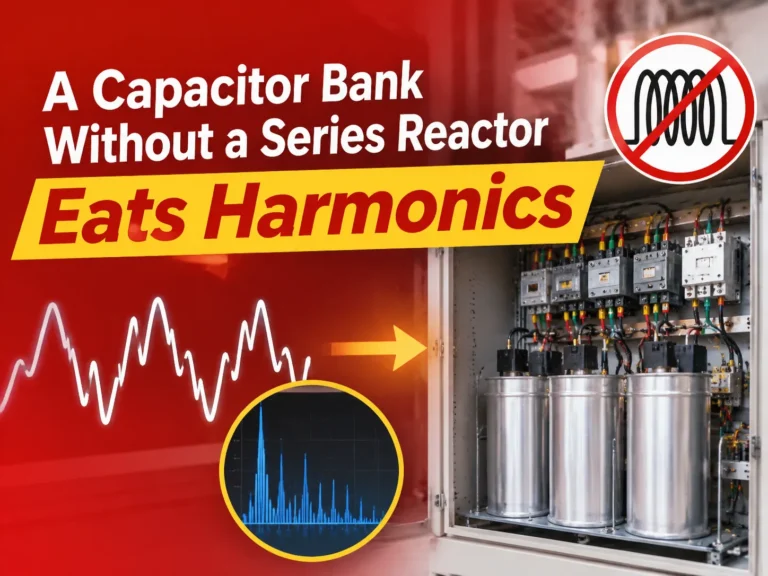
- Harmonics are high, cables and transformers run hot, capacitor banks refuse to switch in, THDu over 5% → APF.
- Both problems on the same busbar → SVG plus APF, sized separately, often in a shared cabinet arrangement.
- Light harmonic content and a tight budget → an SVG model with harmonic suppression capability, accepting that it is a compromise rather than a complete solution.
Where both devices are needed, size them independently against their own measurements. A combined quotation that offers “one hybrid unit to fix everything” is usually a compromise on one of the two jobs.
The KLD-SVG series and the KLD-AMS active filter are built on that same shared platform, which is why they can be installed side by side on the same busbar without fighting each other’s control loops.
FAQ
Can an APF improve the power factor?
It can, partly, because the compensation current it injects has a fundamental component. But its reactive capability is small relative to its harmonic rating, so it is a by-product rather than a design function. If the plant has a genuine reactive deficit, specify an SVG or capacitors.
Can an SVG filter harmonics?
It suppresses a limited amount of low-order harmonic content. It cannot remove 5th and 7th order distortion at the levels produced by a bank of six-pulse drives, and it cannot bring THDu into compliance on its own.
Do I need both devices on the same busbar?
Only when both problems are measured on that busbar. Plenty of plants need one or the other. The measurement report should make the answer obvious; if it doesn’t, the report is not detailed enough.
Why are the two devices so visually similar?
Because both are voltage-source inverters with the same power stage. Manufacturers share the platform to keep costs down and spares common. The application-specific part is the control algorithm and the CT arrangement.