
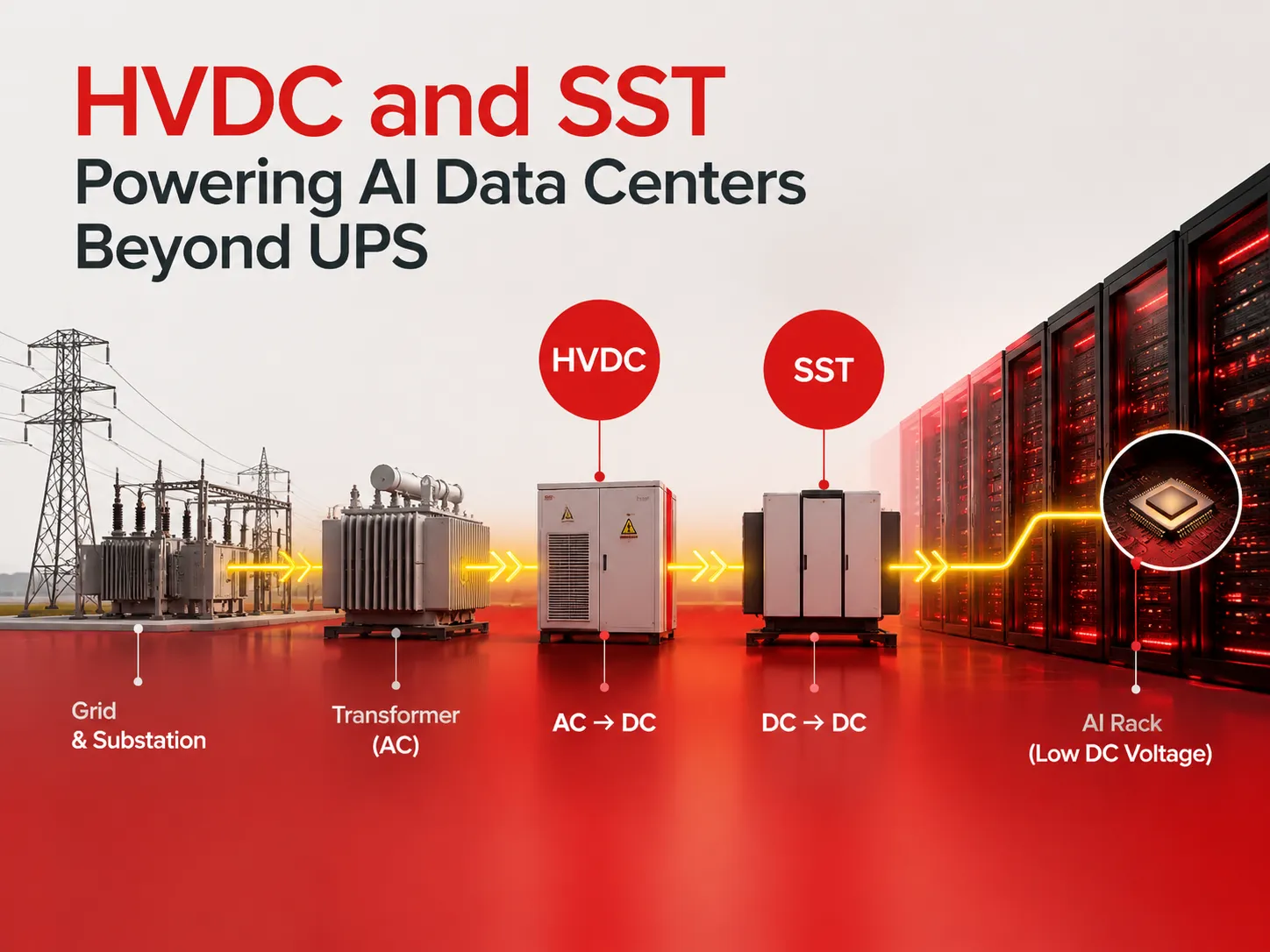
Data center power systems get compared to a heart and a set of blood vessels, and the comparison holds up better than most. Power leaves a distant substation, drops through a chain of transformers, gets converted two or three times, and finally arrives at the chip as a low DC voltage. Every conversion in that chain costs a percent or two. When a single AI rack pulls more than 100 kW, a percent or two stops being rounding error.
That is the case for HVDC distribution and solid-state transformers (SST). Both do the same job: shorten the path from grid to chip, and stop paying for conversions that nobody needs.
Why the Classic UPS Chain Wastes Energy
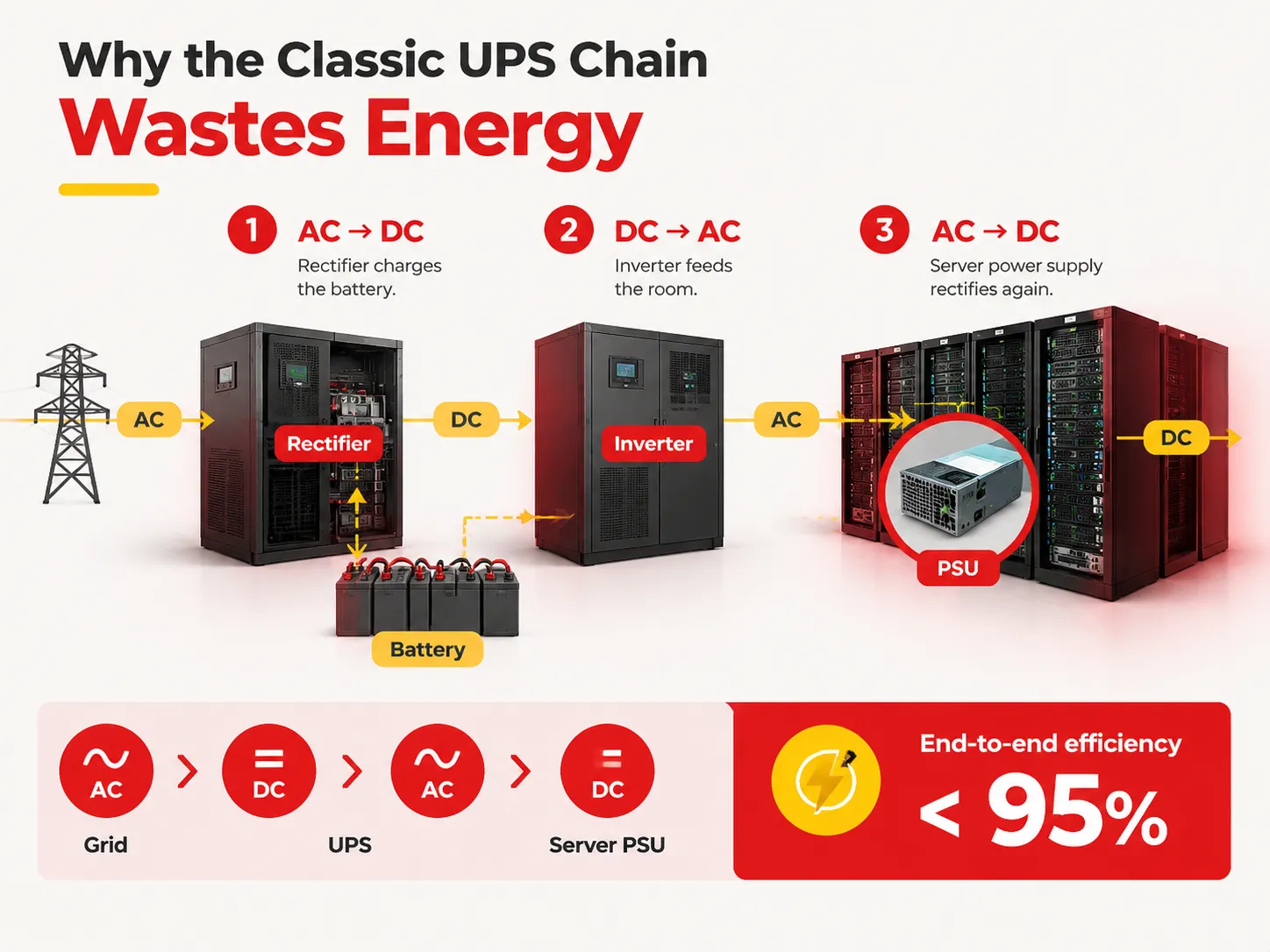
Almost every data center built before the AI era runs on an uninterruptible power supply, and the UPS is a remarkably reliable machine. Its efficiency problem is structural, not a matter of bad engineering. Follow the power:
- Step 1: the AC supply is rectified to DC so the battery string behind the UPS can stay charged.
- Step 2: that DC is inverted back to AC to feed the room.
- Step 3: the server power supply rectifies the AC to DC again, because chips run on DC.
AC to DC, DC to AC, AC to DC. Each conversion loses energy as heat, and the losses stack. A good modern UPS chain lands somewhere under 95% end to end, which sounds respectable until you multiply it by tens of megawatts running 8,760 hours a year.
What HVDC Changes
High-voltage DC distribution collapses the same journey into one conversion: AC in, DC out, and the DC goes straight to the rack. End-to-end efficiency typically moves above 98%. On a 20 MW hall, that difference is measured in millions of kilowatt-hours and in the carbon attached to them.
The architecture is no longer experimental. Google, Microsoft and Meta have all been pushing HVDC into their own facilities, and the internal bus voltage is climbing from the long-standing 240 V toward 400 V and, in some roadmaps, 800 V. Higher voltage means lower current for the same power, which means thinner copper and smaller losses in the rack feed.
HVDC and LVDC Are Not the Same Thing
The two terms get used interchangeably in meetings, and they shouldn’t be. They describe different voltage classes serving different distances:
- HVDC (high-voltage DC): bulk transmission over hundreds of kilometres, such as hydro power from the Jinsha River delivered to Shanghai.
- LVDC (low-voltage DC): what actually runs inside a building, a data hall or an EV charging station, at a few hundred volts.
When someone says “our new hall is HVDC”, they usually mean LVDC at 400 V or 800 V. Worth clarifying in the design review, because the protection gear and the standards are different.
How an HVDC Rack Is Actually Wired
Most 400 V designs follow the same layout. High-voltage DC enters the rack, a bus converter module (BCM) stage drops it to a 48 V rail, and point-of-load converters take it down to 12 V for the boards.
Two practical notes. First, the BCM stage is where most of the remaining loss sits, so it is worth specifying properly rather than treating it as a commodity brick. Second, DC at these currents does not arc the way AC does. It sustains an arc, which changes how you specify breakers, fuses and disconnects.
Solid-State Transformers: The Key Device
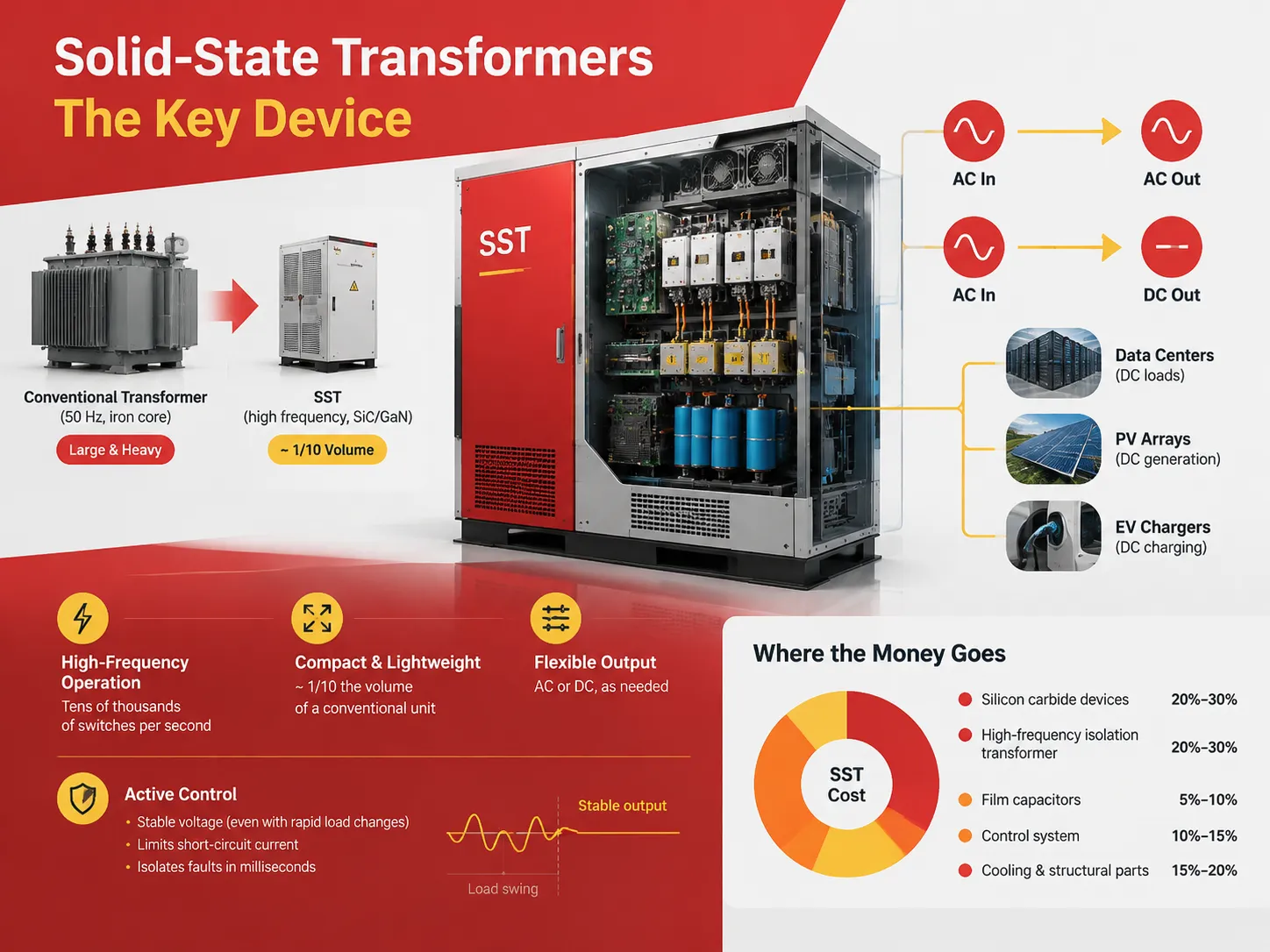
An SST is the piece that makes DC distribution practical at building scale. Instead of a laminated iron core humming at 50 Hz, it switches power at tens of thousands of times per second using silicon carbide (SiC) or gallium nitride (GaN) devices, the same family of semiconductors found in laptop chargers and phone adapters, just scaled up.
Small, light, and flexible about what comes out
Because the transformer inside runs at high frequency, its magnetic core shrinks. An SST occupies roughly one tenth of the volume of a conventional transformer of the same rating. That matters in a data hall where floor space is billed like downtown real estate, and it matters even more in an EV charger or a PV inverter cabinet where there is no room at all.
The other advantage is output flexibility. An SST can take AC in and give AC out, or take AC in and give DC out directly. That single property is why it fits three otherwise unrelated loads so well: server racks that run on DC, PV arrays that generate DC, and EV batteries that charge on DC.
Millisecond control, not just transformation
An iron-core transformer is a passive device. It transforms, and that is the end of the conversation. An SST actively regulates: it holds output voltage steady when GPU load swings from idle to full in a few hundred microseconds, limits short-circuit current instead of letting it run to destruction, and isolates a faulted branch before the upstream protection has finished deciding what happened.
Where the money goes
If you are budgeting an SST project, the cost is distributed roughly like this:
- Silicon carbide devices: 20%–30%
- High-frequency isolation transformer: 20%–30%
- Film capacitors: 5%–10%
- Control system: 10%–15%
- Cooling and structural parts: 15%–20%
The two biggest lines are both semiconductor-adjacent, which is why SST pricing has been tracking SiC module pricing downward rather than following the copper market.
Do the Savings Justify the Change?
For a hall running ten thousand GPUs, yes, and the arithmetic is not close. Efficiency is the headline, but the secondary effects usually decide the project. Higher rack density per square metre, less cooling load because less heat is generated in the first place, and voltage held flat during the load steps that AI workloads produce constantly.
What still needs work is the ecosystem around the hardware: DC-rated protection, selectivity studies for DC faults, staff training, and the fact that many utilities and insurers are more comfortable with an AC single line diagram. Those are real costs and they belong in the business case, not in a footnote.
If your site is at the earlier stage of that journey, the practical order is usually power quality first, then architecture. Harmonic distortion from rectifier-heavy halls is what pushes transformer and neutral temperatures up, and an active power filter is a far cheaper intervention than rebuilding the distribution. Once the waveform is clean and the reactive bill is under control, the case for DC distribution gets easier to defend.
FAQ
Is HVDC safer or more dangerous than AC distribution?
Different, rather than simply safer or worse. At 400 V DC the touch hazard is comparable to 400 V AC, but a DC arc does not self-extinguish at a current zero crossing, because there isn’t one. Protection devices must be DC-rated, and arc-flash studies need to be redone for the DC case.
Can I retrofit an existing data center to HVDC?
Rack by rack, yes. Facility-wide, it usually means waiting for the next hall. The distribution, the UPS room and the cooling topology are all sized around the AC design, so a retrofit is normally a greenfield exercise in practice.
Does an SST replace the UPS?
No. An SST transforms and regulates; it does not store energy. You still need batteries, flywheels or a second source behind it for ride-through, though the amount of storage required drops because the SST rides through short disturbances that would otherwise trip the load.
Where does power quality equipment fit in a DC hall?
On the AC side, upstream. Rectifiers, VFDs and the utility interface still generate harmonics and still draw reactive power, so filtration and compensation remain part of the design. Devices such as an integrated power quality controller handle both in one cabinet when space is tight.